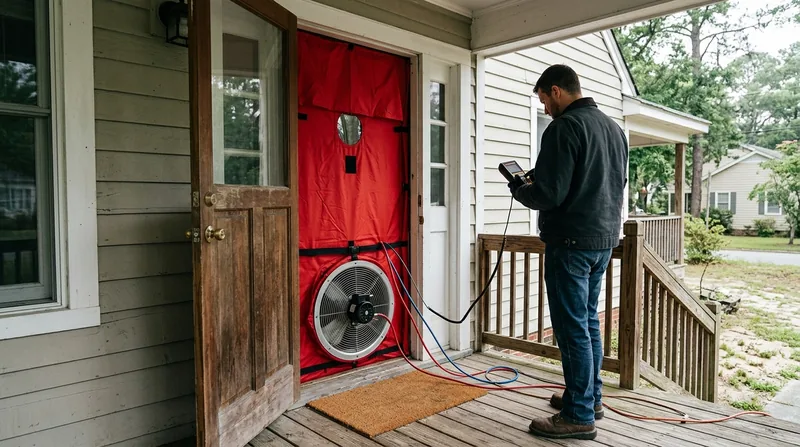




Wilmington homes leak conditioned air year-round through top plates, wall penetrations, rim joists, and ductwork chases that most homeowners never see. The long hot season from May through September drives moisture inward through every gap in the building envelope, and then the cooling system works overtime to compensate. Air sealing in Wilmington finds and closes those leaks with precision testing, so your HVAC system runs efficiently and your indoor humidity stays manageable in this coastal climate. We use a blower door test to measure the air changes per hour at 50 pascals (ACH50) before and after the work, so you know exactly what changed.
Why Air Sealing Matters in Wilmington's Humid Climate
The Cape Fear River valley and the coastal plain around Wilmington sit in IECC climate zone 3A, warm and humid most of the year. Moisture pressure is relentless. Mid-century ranches and historic homes in Forest Hills and downtown Wilmington hold thin, settled insulation and loose framing that lets air move freely in and out. Newer subdivisions pushing toward Leland and Ogden have tighter envelopes, but even those homes develop air leaks at rim joists, penetrations for plumbing and electrical, and attic hatches that were never sealed properly. When you cool a leaky home, you are cooling the outside air that is flowing in through those gaps. When you heat in winter (rare but it happens), you are losing warm air to the same paths. A blower door test quantifies exactly how much air is moving, and then air sealing closes the biggest leaks.
- We identify air leaks using a blower door test that pressurizes the home and shows exactly where air is moving.
- We seal rim joists, top plates, and band joists with spray foam to stop air movement at the foundation and framing interface.
- We close penetrations around plumbing, electrical, and HVAC runs that connect floors and spaces.
- We seal attic access hatches, recessed lights, and ductwork chases that let conditioned air escape into unconditioned spaces.
- We retest with the blower door to confirm the ACH50 improvement and prove the work is complete.
A properly sealed envelope cuts the load on your cooling system and reduces the humidity that settles in crawl spaces and basements. Visit the crawl space spray foam insulation page to understand how air sealing works alongside crawl space conditioning to control moisture from the ground up.
Key info: In Wilmington and Carolina Beach, homes built over vented crawl spaces pull damp coastal air inward through every unsealed gap in the rim joist and band joist. Air sealing these interfaces stops the source of moisture before it reaches the living space above.
For more detail on building code and local permitting for air sealing work, consult the City of Wilmington Building Department, which governs what applies at your address.
How We Air Seal Homes in Wilmington: A Step-by-Step Process
Air sealing starts with measurement and ends with proof. We bring a blower door to your home, seal all large openings like doors and windows, and pressurize the house to 50 pascals. This makes small leaks obvious. We walk the attic, crawl space, rim joists, and interior walls with a smoke pencil and thermal imaging to see where air is moving. Once we have mapped the leaks, we seal them with spray foam, caulk, or weatherstripping depending on the size and location of the gap. Then we retest to show you the improvement in ACH50 and confirm that the work is done right.
- We perform an initial blower door test to establish your baseline ACH50 number and identify the largest air leaks.
- We inspect the attic, crawl space, rim joists, and visible wall penetrations to locate every significant gap.
- We seal rim joists and band joists with closed cell spray foam to create an air-tight and moisture-resistant barrier.
- We close attic penetrations, ductwork chases, and electrical runs with foam or caulk appropriate to the gap size.
- We seal the attic access hatch and any recessed light fixtures that open to unconditioned space.
- We perform a final blower door test to measure the ACH50 improvement and document the results.
The process typically takes one to two days depending on the size of the home and the number of leaks. Learn more about rim joist and band joist sealing, which is often the single largest air leak in a Wilmington home.
Example: A 1960s ranch in Wrightsville Beach with a vented crawl space and original attic insulation showed an ACH50 of 12 before sealing. We sealed the rim joist, closed the attic hatch, and sealed three large penetrations in the attic floor. The final test showed an ACH50 of 6.5, cutting the air leakage in half and reducing the cooling load noticeably in summer.
Air Sealing Methods and Materials
| Method | Material | Best for |
|---|---|---|
| Closed cell spray foam | Two-part polyurethane, 1.5 to 2 lbs per cubic foot | Rim joists, band joists, and large cavities where air tightness and moisture resistance are critical |
| Caulk and sealant | Polyurethane or acrylic latex caulk, 1/4 to 1/2 inch wide | Small cracks, electrical penetrations, and gaps between framing members |
| Weatherstripping | Foam, rubber, or silicone tape | Attic access hatches, door and window frames, and movable joints |
| Open cell spray foam | Two-part polyurethane, 0.5 to 1 lb per cubic foot | Interior wall cavities and attic cavities where cost is a priority and moisture management is not critical |
Closed cell foam is the workhorse of air sealing in Wilmington because it blocks both air and moisture. In a humid climate where the rim joist sits above a damp crawl space, that dual protection matters. Open cell foam is less expensive but absorbs moisture, so we use it only in dry interior spaces. Caulk and weatherstripping are the finishing touches for small gaps that foam cannot reach efficiently.
Air Sealing Cost in Wilmington: What to Expect
Air sealing is priced on a per-project basis after a blower door test and a walkthrough of your home. The cost depends on the size of the home, the number and size of the air leaks, and the materials needed to seal them. A small air sealing job focused on the rim joist and attic access might start at around $650 to $1,200. A comprehensive air sealing that includes the attic, crawl space rim joists, interior penetrations, and ductwork chases typically runs $1,500 to $3,500 depending on the square footage and complexity. Homes with multiple stories, complex roof lines, or extensive crawl spaces cost more because there are more surfaces and more air leaks to address.
The most important factor in the cost is the size and condition of the air leaks. A home with a few large gaps in the rim joist is cheaper to seal than a home with dozens of small penetrations scattered through the attic and walls. Access also matters. A crawl space that is tight and wet costs more to work in safely than one that is open and dry. We always get a free estimate before we start work, so you know the cost up front. Call us at (910) 218-9739 or visit the pricing page to see the typical range for your home size and scope.
Why get an estimate? Because every Wilmington home is different. A 1950s ranch with loose framing and a vented crawl space will have far more air leaks than a 2005 subdivision home with tighter construction. We measure first and price after, so you never pay for guesswork.
What to Look for When Hiring an Air Sealing Contractor Near Wilmington
Air sealing is not complicated, but it is precise work. The wrong installer will spray foam over wet substrates, promise re-entry before the material has cured, or give you an estimate with no R-value or thickness spec. A good contractor measures before and after, explains the blower door results, and walks you through exactly what will be sealed and why. Here is what to check when you call a spray foam insulation contractor near you.
- Ask for a free estimate that includes a blower door test, a written scope of work, and the materials to be used at your address.
- Request references from recent jobs in Wilmington, Leland, or Carolina Beach so you can talk to homeowners who have had the work done.
- Verify that the contractor is fully insured and ask to see the certificate of insurance covering general liability and completed operations.
- Confirm that the contractor understands local building code for air sealing and thermal barriers, and knows what permits apply at your address.
- Ask whether the contractor will perform a final blower door test to prove the improvement in ACH50 and document the work.
- Check the Better Business Bureau and online reviews for patterns of poor workmanship, chemical smell complaints, or delayed re-entry into the home.
If a contractor promises immediate re-entry after spray foam is applied, walks away from a wet crawl space, or quotes a price far below market with no inspection, that is a signal to hire someone else. Contact us for a free estimate and we will show you exactly how we work and what your home needs.
Air Sealing in Wilmington: Pricing Guide
| Service | Price | Details |
|---|---|---|
| Small air sealing project | Starting at $650 | Rim joist sealing, attic access hatch, and one or two interior penetrations with blower door testing |
| Standard home air sealing | Starting at $1,500 | Comprehensive sealing of rim joists, attic penetrations, ductwork chases, and interior walls with before and after blower door test |
| Large or complex home | On estimate | Multiple stories, extensive crawl space, multiple ductwork runs, or tight access requires on-site measurement to establish accurate pricing |
| Travel and setup | Included | No separate mileage fee or travel charge within Wilmington and surrounding areas covered by our service territory |
| Free estimate | No charge | Blower door test, walkthrough, and written scope of work with no obligation to book, response within 24 hours |
Indicative pricing, the exact cost depends on square footage, finish, and site access. Free personalized estimate within 24h at (910) 218-9739.


