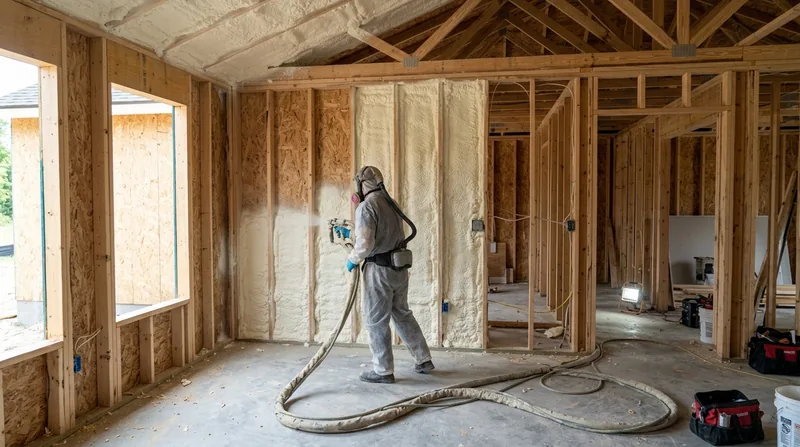




Commercial and new construction spray foam insulation in Wilmington takes shape before the walls close up, and that timing is everything. Builders across New Hanover and Brunswick counties know that foam applied to open framing delivers continuous thermal and air barriers that fiberglass batts cannot match, and the work happens when access is easiest and cost per board foot is lowest. Coastal humidity bears down on Wilmington from June through November, and a new commercial shell or residential build that sits uninsulated through that window absorbs moisture into its framing and cavities before drywall seals it all in. Spray foam installed before walls close stops that moisture and establishes the air barrier from day one. We work with builders, contractors and property managers across the region to spray foam new construction and commercial builds on schedule, with written estimates that name the R-value and thickness you are paying for.
Why New Construction Spray Foam Matters in Wilmington and Brunswick County
A new commercial building or residential frame that goes up in Wilmington sits in a warm, humid climate where the indoor-outdoor temperature and moisture gradient is steep and constant. Fiberglass batts stop some heat flow, but they leave air gaps at plates, headers, and rim cavities, and they do nothing to stop moisture from diffusing into the wall cavity when the air conditioning runs. Spray foam fills every void, hardens into a continuous barrier, and controls both heat and vapor in one pass. For a new build, that means lower energy bills from day one, fewer callbacks for thermal imaging and air leaks, and a shell that will not settle or shift insulation values over time.
- Spray foam applied to open framing costs less per board foot than retrofit work because access is unrestricted and the substrate is clean and dry.
- Continuous insulation and air barrier in one product eliminates the air leakage paths that plague fiberglass-only builds and reduce HVAC load from the start.
- Builders can schedule foam application before drywall delivery, keeping the critical path on track without waiting for separate air sealing trades.
- New construction foam is inspected and documented before concealment, so there is a clear record of coverage, thickness and R-value for the building owner.
Builders who specify foam before walls close avoid the cost and complexity of retrofit air sealing and the energy penalties of incomplete insulation.
Key info: North Carolina building code (IECC 2021 or as adopted locally) requires continuous insulation in new commercial construction. Spray foam meets that requirement in a single application and eliminates the thermal bridging that fiberglass batts alone cannot address. Check your local building department for the exact code in force at your address.
For more on the science and performance of foam in commercial and new builds, see our page on closed cell spray foam insulation, which is the standard for new construction thermal and moisture control.
How We Install Spray Foam in New Construction: The Process
New construction work follows a clear sequence tied to the building schedule. We coordinate with the general contractor to arrive after framing and rough-in utilities are complete but before drywall delivery. The substrate must be dry, clean, and free of debris or standing water. We inspect the framing, identify any moisture or contamination that would prevent foam adhesion, and walk the job with the builder to confirm the scope and any special requirements such as fire ratings or thermal barrier placement.
- We receive the building plan and schedule, and coordinate the spray date to fit the construction timeline without delaying drywall delivery.
- On arrival, we inspect the substrate for moisture, dust, and any conditions that would prevent proper foam cure and adhesion.
- We set up spray equipment outside the building, run hoses to each zone, and establish mechanical ventilation to manage fumes during application.
- We spray foam to the specified thickness and R-value, working systematically through walls, rim cavities, band joists, and any other cavities in the scope.
- We verify coverage and thickness with physical measurement and photo documentation before leaving the site.
- We provide the builder with a written record of board feet applied, R-value achieved, and any conditions noted during installation.
This systematic approach ensures that the building envelope is complete before concealment and that the builder has a clear record of what was installed and where.
Example: A 12,000-square-foot commercial office building going up in Leland needs closed cell foam in all exterior walls and under the roof deck to meet continuous insulation code. We coordinate with the general contractor to spray after framing and mechanical rough-in, apply 2 inches of closed cell to walls and 3 inches under the roof deck, and provide a signed completion report before drywall delivery. The building passes thermal imaging inspection the first time.
Learn more about air sealing techniques that complement spray foam in new construction work.
Spray Foam Methods for New Construction and Commercial Shells
| Approach | Description | Best For |
|---|---|---|
| Closed Cell Spray Foam | High-density foam (3.5 to 3.6 lbs/cu ft) with high R-value per inch (6.0 to 6.5) and vapor barrier properties. Adheres firmly to framing and hardens in minutes. | Exterior walls, roof decks, rim cavities, and any zone where thermal and moisture control are critical. Standard for new construction in humid climates. |
| Open Cell Spray Foam | Lower-density foam (0.5 to 1.5 lbs/cu ft) with R-value around 3.5 per inch. Softer, more flexible, and allows vapor diffusion. Slower cure, requires longer ventilation. | Interior walls, sound dampening, and new builds where cost per square foot is the primary driver and moisture control is secondary. |
| Hybrid (Closed Cell Base with Open Cell Top) | 2 to 3 inches of closed cell for vapor barrier and structural adhesion, topped with open cell for sound dampening and cost efficiency. Combines performance and budget. | Commercial shells, office buildings, and mixed-use structures where thermal control and acoustic performance are both required. |
| Rim and Band Joist Foam | Closed cell foam applied to rim cavities and band joists to seal the thermal break between foundation and first floor. Typically 1.5 to 2 inches thick. | All new construction with raised foundations or basements. Stops thermal loss and air leakage at the perimeter where it is most pronounced. |
Commercial and New Construction Spray Foam Cost in Wilmington: What to Expect
The cost of spray foam in new construction depends on the square footage of the building, the type of foam chosen, the thickness required by code, and site access. A free commercial estimate is the starting point. We visit the site, review the building plan, measure the areas to be sprayed, and provide a written estimate that breaks down the R-value, thickness, board feet, and total cost. Builders and property managers can then compare our estimate to other bids and understand exactly what each price includes.
Closed cell foam costs more per board foot than open cell, but delivers higher R-value per inch and stronger moisture control, which justifies the cost in humid climates like Wilmington. A new 10,000-square-foot office shell in Wilmington that requires 2 inches of closed cell in exterior walls and under the roof deck will typically run into five figures, depending on site conditions and accessibility. A smaller residential new build with open cell in interior walls only will be significantly less. The only way to know your cost is to request an estimate with the square footage and code requirements for your specific project.
See our full pricing overview for ranges and details on what moves the cost up or down. Call us at (910) 218-9739 to schedule your free commercial estimate.
What to Look for When Hiring a Spray Foam Contractor Near Wilmington
Hiring the right spray foam contractor for new construction means checking credentials, understanding the scope, and verifying that the installer knows the local building code and can document the work properly. North Carolina does not license insulation installers at the state level, so the burden falls on you to verify insurance, ask for references, and confirm that the contractor can provide written estimates with R-value and thickness specifications. A reputable contractor will be fully insured, will name the code in force at your address, and will walk you through the estimate before work begins.
- Verify that the contractor is fully insured and can provide proof of liability and workers' compensation coverage before work starts.
- Request at least two other estimates from competitors so you can compare scope, R-value, thickness, and price side by side.
- Ask for references from recent new construction or commercial projects and follow up with builders or property managers who hired them.
- Confirm that the contractor understands the local building code (IECC 2021 or as adopted in your city) and can explain why the foam type and thickness they are recommending meets that code.
- Check that the estimate includes written documentation of board feet, R-value, and thickness, not just a dollar amount.
- Ask about the ventilation plan during cure and the re-entry window. A contractor who promises immediate occupancy is cutting corners.
A contractor who provides a clear estimate, answers your questions directly, and can back up their work with references is the one worth hiring. If you are ready to move forward, contact us for a free estimate and a conversation about your project.
For detailed guidance on what to look for in any spray foam contractor, including what to avoid, visit the North Carolina General Contractors Association for contractor verification resources.
Commercial & New Construction Spray Foam in Wilmington: Pricing Guide
| Service | Price | Details |
|---|---|---|
| Free Commercial Estimate | Free | Site visit, plan review, scope definition, written estimate with R-value and thickness specifications |
| Closed Cell Spray Foam (New Construction) | Starting at $1.50 per board foot | High R-value, vapor barrier, moisture control. Price varies by thickness, building size, and site access conditions |
| Open Cell Spray Foam (New Construction) | Starting at $0.75 per board foot | Lower cost, good for interior applications, sound dampening. Thickness and building square footage affect final cost |
| Hybrid Foam Installation (Closed Cell Base, Open Cell Top) | Starting at $1.10 per board foot | Combines thermal control and cost efficiency. Price depends on the ratio of closed to open cell and total coverage area |
| Large-Scale Commercial or Multi-Building Projects | On Estimate | Complex scope, multiple buildings, or site logistics require on-site assessment before pricing |
| Travel and Scheduling | Included | No separate mileage fee or call-out charge for Wilmington and surrounding service areas |
Indicative pricing, the exact cost depends on square footage, finish, and site access. Free personalized estimate within 24h at (910) 218-9739.


