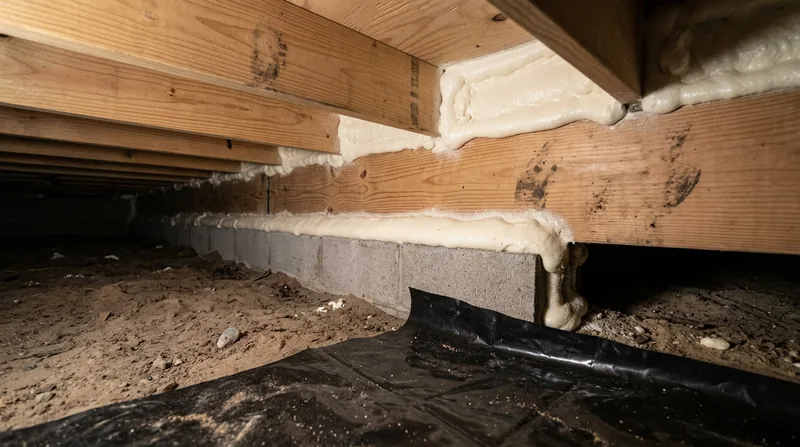




Wilmington's older homes and mid-century ranches sit over vented crawl spaces where the rim joist and band joist, the horizontal framing that connects the foundation wall to the floor system, often leak humid coastal air directly into the floor cavity. In the warm, damp climate of New Hanover, Brunswick, and Pender counties, this air carries moisture that settles under floors year-round, driving up cooling bills and creating conditions for eventual wood decay. Rim joist and band joist spray foam seals this critical junction with closed cell foam, blocking both drafts and the humid air that comes off the Cape Fear River and the Atlantic. This is not a cosmetic upgrade; it is the difference between a floor that stays dry and one that absorbs moisture from below. We use closed cell foam at this location because the rim joist sits at the thermal and moisture boundary where the conditioned floor meets the unconditioned crawl space, and closed cell's density and vapor resistance are the right tool for that job. A single afternoon of work on the band joist can cut floor-level drafts and humidity infiltration more effectively than most homeowners expect, and the cost is a fraction of what a failed rim joist repair will eventually demand.
Why Rim Joist and Band Joist Sealing Matters in Wilmington's Coastal Crawl Spaces
The rim joist is where the floor frame sits on the foundation wall, and it is the most common air leak in Wilmington homes with crawl spaces. Vented crawl spaces pull in humid outdoor air through the vents, and that air rises through gaps, cracks, and unsealed rim joists into the floor cavity above. In summer, when outdoor humidity sits above 70 percent, the rim joist becomes a highway for moisture that makes floors feel clammy, drives up air conditioning costs, and can eventually weaken the wood framing itself. Older homes downtown and in Forest Hills often have narrow, irregular rim joist cavities that are difficult to seal with traditional fiberglass or batts, but closed cell foam conforms to the space and creates an airtight seal in a single pass.
- Closed cell foam blocks humid air from rising through the rim joist cavity into the floor above.
- The seal stops drafts that make lower floors feel cold in winter and humid in summer.
- Sealed rim joists reduce the workload on air conditioning equipment and lower monthly utility bills.
- The foam resists moisture absorption and does not degrade in damp crawl space environments.
- A properly sealed rim joist protects the floor framing from the wood rot and fungal growth that follow prolonged moisture exposure.
Sealing the rim joist is one of the highest-return air sealing jobs in a Wilmington home, and it is often the first step in a larger crawl space or floor insulation project.
Key info: Wilmington's vented crawl spaces pull in damp coastal air during warm months, and that moisture travels straight up through unsealed rim joists. A homeowner in Leland or Carolina Beach with a clammy first floor and rising cooling costs almost always has an open rim joist cavity. Sealing it stops the leak at the source.
For more on how moisture moves through crawl spaces and why sealing is critical, see our full crawl space spray foam insulation page.
How We Seal Rim Joists and Band Joists in Wilmington Crawl Spaces
Rim joist sealing is a straightforward job that starts with access to the crawl space and a clear view of the rim joist cavity where the floor frame meets the foundation. We inspect the rim joist for existing insulation, gaps, and any visible moisture or damage, then prepare the surface by removing loose debris and ensuring the substrate is dry. We apply closed cell foam in controlled passes to build the specified thickness (typically 1.5 to 2 inches for an R-value of R-9 to R-12), allowing each pass to cure before the next, and we maintain mechanical ventilation during the application and cure period to manage off-gassing. After cure, we allow a re-entry window of 24 to 48 hours before the homeowner uses the space above, and we provide a written summary of the foam type, thickness, and R-value applied.
- We access the crawl space from the foundation vents or access doors and inspect the rim joist for condition and existing insulation.
- We clear the rim joist surface of loose debris and verify the substrate is dry before application begins.
- We spray closed cell foam in controlled passes, building to the specified thickness in a single visit.
- We maintain mechanical ventilation throughout application and cure to manage vapor and off-gassing.
- We provide a written estimate with R-value and thickness specifications before any work begins.
- We observe a 24 to 48-hour re-entry window and confirm cure before the homeowner resumes normal use of the floor above.
The entire job typically takes 2 to 4 hours depending on the linear footage of rim joist, crawl space access, and any obstacles like ducts or plumbing.
Example: A mid-century ranch in Hampstead with 150 linear feet of rim joist and a vented crawl space pulled in humid air through gaps in the band joist cavity. We sealed the entire rim joist with 1.5 inches of closed cell foam, achieving R-9 in a single afternoon. The homeowner reported noticeably drier floors within two weeks and a measurable drop in summer cooling costs by the following month.
For a complete overview of spray foam application methods and closed cell specifications, visit our closed cell spray foam insulation page.
Rim Joist and Band Joist Sealing Methods and Materials
| Method | Description | Best for |
|---|---|---|
| Closed Cell Spray Foam (1.5 to 2 inches) | High-density foam applied in controlled passes; achieves R-9 to R-12 and creates an airtight, moisture-resistant seal in the rim joist cavity. | Vented crawl spaces in Wilmington's coastal climate where humidity control and air sealing are both priorities. |
| Closed Cell Foam with Thermal Barrier (if required) | Closed cell foam applied to the rim joist with a thermal barrier (intumescent paint or ignition barrier) to meet code where the crawl space is accessed from living space. | Older homes where building code or the local building official requires a fifteen-minute thermal barrier between foam and the floor cavity above. |
| Rim Joist Foam Plus Adjacent Wall Sealing | Closed cell foam applied to the rim joist and extended up the foundation wall to seal the band board and any gaps where the rim meets the sill plate. | Crawl spaces with visible gaps between the rim and foundation, or where air sealing of the entire thermal envelope is the goal. |
| Retrofit Sealing of Existing Cavities | Removal of failed or inadequate insulation from the rim joist, followed by closed cell foam application to achieve full coverage and R-value. | Homes where the rim joist was previously insulated with fiberglass or foam that has settled, shifted, or absorbed moisture. |
Rim Joist and Band Joist Spray Foam Cost in Wilmington: What to Expect
Rim joist sealing in Wilmington typically starts at $650 for a modest crawl space with accessible rim joist and 80 to 120 linear feet of band joist to seal. The final cost depends on the linear footage of rim joist, the accessibility of the crawl space (tight or easy entry, obstructions like ducts or plumbing), the thickness specified (1.5 to 2 inches is standard), and whether thermal barrier application is required by code. A larger home in Wrightsville Beach or Southport with 200+ linear feet of rim joist and a more complex crawl space layout may run $1,200 to $1,800. The best way to know your actual cost is to request a free written estimate from our team; we measure the rim joist on site, specify the foam type and thickness in writing, and provide a firm quote before any work begins.
Factors that move the price up include narrow or blocked crawl space access that requires extra time to navigate, existing failed insulation that must be removed first, and local code requirements for thermal barriers or ignition protection. Factors that keep the cost down include straight, unobstructed rim joists with good crawl space access and no prior insulation to remove. We include all material, labor, and mechanical ventilation during cure in our estimate; there are no hidden costs or surprise charges when the job is done.
For a detailed breakdown of pricing and what affects the cost of your specific job, see our full pricing guide.
Rim Joist and Band Joist Spray Foam Near Me: What Wilmington Homeowners Should Know When Hiring a Contractor
Hiring the right spray foam contractor for rim joist sealing is straightforward if you know what to look for. Start by asking any contractor whether they carry full insurance and can provide a certificate of insurance on request; we do, and we are happy to share it. Get written estimates from at least two local contractors that include the foam type, thickness in inches, and R-value they will apply, plus the total cost and timeline. If a contractor gives you a price with no specification of thickness or R-value, or promises immediate re-entry after the job, walk away; these are the markers of inexperienced or careless work. Ask about mechanical ventilation during cure and the re-entry window the contractor will observe; responsible shops manage off-gassing and maintain a 24 to 48-hour re-entry window. Check whether the contractor is familiar with Wilmington's local building code and permitting requirements; rim joist sealing itself rarely requires a permit, but the contractor should know what does and does not apply in your specific address.
- Request a written estimate that specifies foam type, thickness, R-value, and total cost before signing anything.
- Verify that the contractor carries full insurance and can provide proof on request.
- Ask about mechanical ventilation during application and the re-entry window the contractor will observe.
- Get references from recent rim joist or crawl space jobs in Wilmington or nearby areas and actually call them.
- Confirm that the contractor understands local building code and will alert you if any permits or inspections are required at your address.
- Avoid contractors who offer a price far below market, promise immediate re-entry, or cannot specify thickness and R-value in writing.
For a free, no-obligation estimate from our team, call (910) 218-9739 or visit our contact page to request an appointment. We respond within 24 hours and will walk you through the entire process before you decide to move forward.
We have been serving Wilmington, Leland, Carolina Beach, Wrightsville Beach, Hampstead, and surrounding areas since 2016, and we bring the same expertise to every rim joist job, whether it is a small-footprint cottage in downtown Wilmington or a larger home in a newer subdivision. Our goal is straightforward: seal the leak, specify the work in writing, and leave you with a drier, more efficient home.
Rim Joist & Band Joist Spray Foam in Wilmington: Pricing Guide
| Service | Price | Details |
|---|---|---|
| Rim Joist Sealing (80 to 120 linear feet) | Starting at $650 | Closed cell foam 1.5 to 2 inches, basic crawl space access, no prior insulation removal |
| Rim Joist Sealing (150 to 200 linear feet) | Starting at $1,050 | Closed cell foam 1.5 to 2 inches, standard crawl space conditions, moderate footage and complexity |
| Rim Joist with Thermal Barrier or Complex Access | Starting at $1,200 | Closed cell foam plus ignition barrier if code-required, tight crawl space, or prior insulation removal needed |
| Large Crawl Space or Full Rim and Foundation Wall Sealing | On estimate | 200+ linear feet, extensive foundation wall sealing, or combined with other crawl space work requires on-site measurement |
| Travel and Mobilization | Included | No separate travel fee or mileage charge within Wilmington and surrounding service areas |
| Free Written Estimate | Free | Includes site visit, foam type and thickness specifications, R-value, and total cost, response within 24 hours |
Indicative pricing, the exact cost depends on square footage, finish, and site access. Free personalized estimate within 24h at (910) 218-9739.


