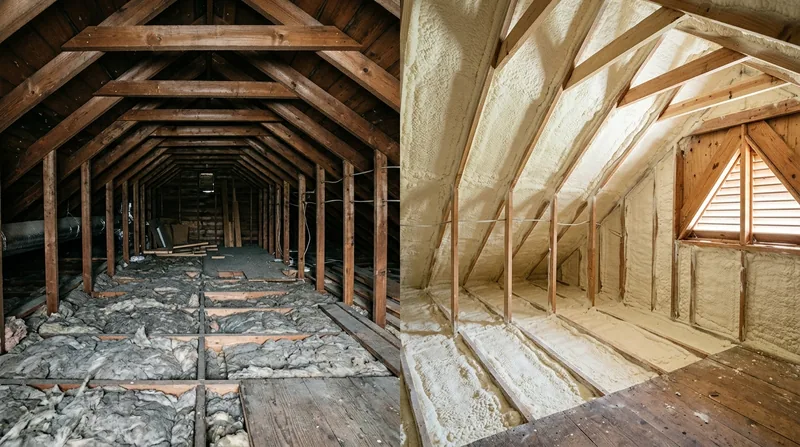




Wilmington's housing stock, from the historic downtown and Forest Hills neighborhoods to the mid-century ranches spreading toward Ogden and the newer subdivisions near Leland and the beach communities, sits in a climate that demands constant cooling and battles humidity year-round. Most of this coastal-plain building rests over vented crawl spaces or slabs on sandy ground, with attics that bake through long hot summers and hold whatever insulation came with the original build. Old fiberglass, cellulose, and blown-in mineral wool settle, compress, and fail in this heat and humidity. Insulation Replacement and Re-Insulation in Wilmington means pulling out that failed material and installing spray foam built for this environment, so your whole house performs the same way, room to room. We remove old insulation from attics, walls, and crawl spaces, then re-insulate with closed cell or open cell foam that controls moisture, seals air leaks, and holds its R-value for decades in the Cape Fear region's demanding climate.
Why Insulation Replacement Matters in Wilmington's Hot, Humid Climate
Wilmington sits in IECC climate zone 3A, warm and humid at the mouth of the Cape Fear River, with moisture bearing down most of the year. In summer, heat drives through thin attic insulation and moisture-laden air infiltrates through every gap in walls and crawl spaces. Vented crawl spaces pull in damp coastal air that settles under floors across New Hanover, Brunswick, and Pender counties, cooling bills climb every season, and that cost tracks straight back to old insulation that has failed. When fiberglass settles, cellulose compacts, or mineral wool loses its grip, you lose R-value and gain air leaks. Replacing that material with spray foam seals the gaps that fiberglass leaves behind, controls the moisture that destroys older materials, and stops the thermal short-circuits that make your HVAC run all day and night.
- Old insulation settles and compresses, dropping R-value by 20 to 40 percent over 20 to 30 years in attics and crawl spaces.
- Vented crawl spaces under Wilmington homes pull in humid coastal air that wicks into rim joists, band joists, and rim board, rotting wood and driving cooling costs higher.
- Fiberglass and blown-in materials leave air gaps around rim joists, band joists, electrical chases, and plumbing penetrations that spray foam seals completely.
- Spray foam holds its R-value in heat and humidity, resisting moisture and settling for the life of the house.
Replacing failed insulation with foam is not a cosmetic upgrade, it is the foundation of thermal control in a house that sits in one of the hottest and most humid climates in the eastern United States.
Key info: A mid-century ranch in Wilmington with original fiberglass in the attic and an uninsulated crawl space typically loses 30 to 40 percent of conditioned air through the envelope. Replacing that insulation with closed cell foam in the attic and crawl space seals the thermal boundary and cuts cooling costs measurably. See the crawl space spray foam insulation page for details on the most common replacement job in the region.
For official guidance on what insulation standards apply in Wilmington, the City of Wilmington building department enforces the energy and building codes in force at your address and can clarify attic ventilation and thermal barrier requirements for your specific project.
How We Remove Old Insulation and Re-Insulate Your Wilmington Home
Insulation replacement starts with diagnosis. We inspect attics, crawl spaces, walls, and rim joists to assess what is failing, where air is leaking, and what the substrate looks like. If old insulation is wet, contaminated, or sits over a leaking roof or crawl space with standing water, we fix the moisture first or we walk away. Once the substrate is dry and sound, we remove the old material, seal air leaks with foam or sealant, install the right foam type for the space and use case, and document the R-value and thickness so you have a record of what was installed. The whole process takes one to three days depending on house size and complexity.
- We inspect the attic, crawl space, walls, and rim joists to identify failed insulation, air leaks, moisture, and substrate condition.
- We remove old fiberglass, cellulose, mineral wool, or failed foam by hand or with vacuum extraction equipment.
- We seal air leaks around electrical chases, plumbing penetrations, rim joists, and band joists with spray foam or sealant.
- We install closed cell or open cell foam at the thickness and R-value your house needs, with mechanical ventilation during cure.
- We provide written documentation of R-value, thickness in inches, and coverage area so you have proof of what was installed.
This methodical approach ensures the replacement insulation performs as designed and is built to last in Wilmington's hot, humid climate.
Local example: A Forest Hills home with a 1970s attic of settled fiberglass and a vented crawl space under the first floor came to us with $250-a-month summer cooling bills. We removed the attic insulation, sealed air leaks around the roof penetrations and electrical chases, installed 5 inches of closed cell foam (R-30), and re-insulated the crawl space rim joists. The homeowner saw a measurable drop in cooling costs within the first month, and the house stayed dry through the next humid season. That is the result of replacement done right.
Learn more about attic spray foam insulation and insulation removal to understand the full scope of what a replacement job entails.
Insulation Replacement Methods: Closed Cell, Open Cell, and Blown-In
| Approach | Description | Best for |
|---|---|---|
| Closed Cell Spray Foam | Dense, rigid foam sprayed at 1.5 to 2 pounds per cubic foot, R-6 to R-7 per inch, fully closed cells that block moisture and air. Cures hard and provides structural support. | Attics, crawl spaces, rim joists, and walls in Wilmington homes where moisture control and air sealing are critical. Sealed roof decks and vented attics where condensation risk is high. |
| Open Cell Spray Foam | Lighter foam sprayed at 0.5 pounds per cubic foot, R-3.5 per inch, open cells that allow vapor transmission. Cures soft and absorbs sound. Lower cost per board foot than closed cell. | Attic cavities in newer homes where ventilation is in place and vapor can move. Sound dampening in garage ceilings and interior walls. Budget-conscious re-insulation of sound attics where air sealing is not the primary goal. |
| Blown-In Fiberglass or Cellulose (Top-Up) | Loose-fill material blown into cavities to add depth and R-value. No air sealing. Simple and fast for attics with sound existing insulation that needs depth. | Adding R-value to an attic that already has working insulation and no major air leaks. Not recommended for crawl spaces or rim joists in humid climates. |
| Injection Foam (Wall Cavities) | Low-pressure closed cell foam injected into existing wall cavities through small holes, no demolition. Fills narrow and irregular bays in historic stock. Seals air gaps and adds R-value to solid walls. | Historic Wilmington homes and Forest Hills neighborhoods with narrow or irregular wall cavities. Retrofit without removing drywall or siding. Moisture control in old coastal homes where exterior walls absorb humidity. |
The right method depends on the space, the existing condition, your budget, and your climate. We help you choose based on what the house needs, not what sounds most impressive.
Insulation Replacement and Re-Insulation Cost in Wilmington: What to Expect
Insulation replacement in Wilmington typically starts at $2,800 for a small attic or crawl space top-up, and scales with the square footage, insulation type, and complexity of the job. A full attic replacement in a mid-size Wilmington home, including removal and closed cell foam installation, runs $4,500 to $8,000. A crawl space replacement with rim joist sealing and closed cell foam runs $3,500 to $6,500. Injection foam in a historic home's exterior walls runs $2,500 to $5,000 depending on wall length and cavity depth. The biggest cost drivers are the size of the space, whether you choose closed cell or open cell foam, the thickness of foam needed to meet your R-value target, and whether the substrate needs cleaning or repair before foam goes down.
Getting 2 to 3 written estimates with R-value and thickness specs is essential. A solid estimate will break down the square footage or board feet, the foam type and thickness, the R-value per inch and total, removal costs if old insulation is coming out, and any air sealing or substrate work. It will also list what is included in the price and what is not (travel, permits, inspections). Avoid estimates with no R-value, no thickness, a price far below market, or a promise of immediate re-entry. Those are signs of rushed or incomplete work.
Visit the pricing page for a detailed breakdown of what each service type costs and what factors move the price up or down.
What to Look for When Hiring an Insulation Contractor Near Me in Wilmington
Hiring the right spray foam contractor is the difference between a house that stays dry and comfortable for decades and one that smells like chemicals, stays damp, or loses R-value in five years. The trade has its rig-and-run crews (an out-of-state trailer, a job sprayed in an afternoon, nobody reachable when the smell will not go away) and its national franchises, and the local independent is positioned against both. Here is how to verify any contractor, including us.
- Ask for proof of full insurance coverage and request a certificate of insurance naming your address as an additional insured before work starts.
- Get a written estimate with R-value per inch, total thickness in inches, square footage or board feet, and a breakdown of removal, foam installation, and air sealing costs.
- Ask how long mechanical ventilation will run during cure and what the re-entry window is (typically 24 to 48 hours for spray foam).
- Check references from at least two Wilmington or nearby jobs completed in the last 12 months, and contact those homeowners directly.
- Confirm that your local building department does not require a permit for your specific job, and if it does, that the contractor will help you navigate the process.
- Ask whether the contractor will inspect the substrate before spraying and walk away if moisture or contamination is present.
A contractor who gives you a firm price with no site visit, promises immediate re-entry, or cannot name references is not the one to hire. The honest position, which is also the strongest selling point, is correct installation, controlled thickness per pass, proper equipment ratio and temperature, mechanical ventilation during cure, and a stated re-entry window. That is what separates a durable job from a regrettable one.
Call us at (910) 218-9739 for a free, no-obligation estimate and a walk-through of your specific situation. We will give you a written estimate with R-value and thickness specs, answer your questions, and be reachable if you have concerns after the job is done.
For more guidance on hiring and verifying contractors in Wilmington, contact us at our contact page.
Insulation Replacement & Re-Insulation in Wilmington: Pricing Guide
| Service | Price | Details |
|---|---|---|
| Attic Replacement (Small, Open Cell) | Starting at $2,800 | Removal of old insulation and 3 to 4 inches of open cell foam, up to 1,000 square feet, includes air sealing |
| Attic Replacement (Medium, Closed Cell) | Starting at $5,200 | Removal of old insulation and 5 to 6 inches of closed cell foam, 1,000 to 1,500 square feet, includes rim joist sealing |
| Crawl Space Replacement with Rim Joist Sealing | Starting at $3,500 | Removal of old insulation, closed cell foam on rim joists and band joists, partial floor coverage, typical 800 to 1,200 square feet |
| Wall Injection Foam (Historic or Retrofit) | Starting at $2,500 | Low-pressure injection foam in existing wall cavities, no demolition, 400 to 600 linear feet of wall, moisture control in coastal homes |
| Large or Complex Re-Insulation Job | On estimate | Multi-zone replacement, substrate repair, structural concerns, or custom specifications require site inspection and written scope |
| Travel and Estimate | Included and Free | No separate travel fee in Wilmington and surrounding areas, free written estimate within 24 hours at (910) 218-9739 |
Indicative pricing, the exact cost depends on square footage, finish, and site access. Free personalized estimate within 24h at (910) 218-9739.


