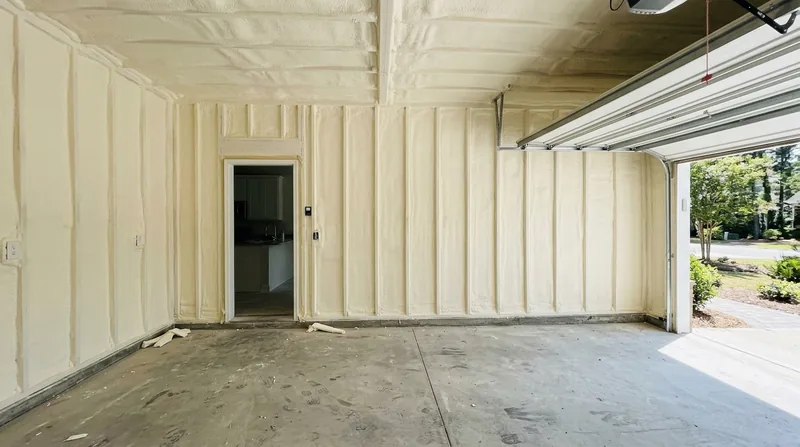




Garage spray foam insulation in Wilmington stops the heat transfer through shared walls and ceilings that turn attached garages into thermal radiators during the long coastal summer. Wilmington's newer subdivisions toward Leland and Ogden pack rooms over garages, while older mid-century ranches run attached single-story garages with thin or missing insulation between the heated house and the garage cavity. That gap costs money every month from June through September, and it costs more in September when humidity is highest and cooling runs hardest. We foam the shared wall and ceiling to cut that transfer, seal the air leaks around doors and rim joists, and hold the moisture that drives inward through hot humid walls. The work is straightforward, the payoff is immediate, and it changes how a house feels when the sun is at its worst.
Why Garage Insulation Matters in Wilmington's Heat and Humidity
Wilmington sits in IECC climate zone 3A, warm and humid year-round, with summers that push attics and garages into the 120-plus degree range by afternoon. An uninsulated garage ceiling is a direct thermal bridge to the living space above or to the room beside it. The coastal air that feeds into vented crawl spaces and wall cavities carries moisture that settles against cold surfaces in air conditioning season, and an uninsulated garage wall lets that humid air conduct straight into the conditioned space. Foam stops both the heat and the moisture migration, and it does so in a single pass without the settling, compression, and air gaps that plague blown-in fiberglass over decades.
- An uninsulated garage ceiling allows summer heat to radiate directly into the room above, raising cooling load by 10 to 15 percent in that zone.
- Spray foam creates an air seal that blocks humid coastal air from migrating through wall cavities and settling on cold ducts or framing in air conditioning season.
- Closed cell foam holds its R-value and resists moisture absorption, critical in Wilmington's humid climate where open cell foam can absorb water from salt air.
- The shared wall of an attached garage is the single largest uninsulated surface in most Wilmington homes, and it is the cheapest energy retrofit to execute.
Foam the garage right, and you cut the cooling load on that zone while stopping the moisture that drives mold and odor in humid climates.
Key info: Most Wilmington garages built before 2010 have no insulation or only kraft-paper-faced fiberglass that has settled to 2 to 3 inches of effective depth. A 2-inch closed cell foam layer on the ceiling and shared wall of a standard two-car garage runs roughly 400 to 500 board feet and delivers R-13 to R-16, enough to drop that zone's cooling load by a measurable margin.
For more on how foam controls moisture in high-humidity settings, see our closed cell spray foam insulation page.
How We Insulate Garage Ceilings and Walls in Wilmington
We start with a walk-through to map the garage cavity, identify rim joists or band joists that need sealing, and check for any active moisture or roof leaks. If the substrate is wet or the roof is actively leaking, we stop and refer you to the right contractor, because foam over a wet surface fails and traps moisture. Once we confirm the space is dry and ready, we set up mechanical ventilation to manage cure fumes, mask off the work zone, and spray the foam in controlled passes to hit the thickness and R-value your estimate calls for.
- We inspect the ceiling and shared wall for existing insulation, air leaks, and any signs of roof or plumbing leaks before we quote.
- We establish a re-entry window of 24 to 48 hours and provide clear guidance on ventilation and occupancy during cure.
- We foam the ceiling first, then the shared wall, sealing rim joists and any penetrations where utilities pass through to the garage.
- We verify thickness and R-value on site and document the job with photos and a written record of what was installed.
The whole process for a standard two-car garage typically runs one to two days, depending on whether we are also sealing rim joists or doing removal of old insulation first.
Example: A Leland homeowner with a 1990s ranch and a two-car garage under a second-story bedroom called because the bedroom was hot and humid in summer. We found the garage ceiling had no insulation and the rim joist was open to the crawl space below. We sprayed 2 inches of closed cell on the ceiling and rim joist, sealed the wall penetration where a water line ran through, and set up a re-entry window of 48 hours. The bedroom temperature dropped 3 to 4 degrees by mid-August, and the humidity fell enough to stop the musty smell.
Learn more about rim joist and band joist sealing and how it ties to garage insulation.
Garage Insulation Methods: Closed Cell vs. Open Cell
| Approach | Description | Best for |
|---|---|---|
| Closed Cell Spray Foam | Rigid, high-density foam at 2 to 3 pounds per cubic foot. Delivers R-6 to R-7 per inch. Resists moisture absorption and acts as an air and vapor barrier. | Wilmington garages in humid climates. Preferred for ceilings and walls where moisture migration is the risk. |
| Open Cell Spray Foam | Soft, low-density foam at 0.5 pounds per cubic foot. Delivers R-3.6 per inch. Allows vapor to pass through, so it works best with a separate vapor barrier. | Garage interiors where sound dampening is a goal and moisture risk is low. Less common in Wilmington's humid setting. |
| Closed Cell + Air Sealing | Foam the ceiling and shared wall, then seal rim joists, door frames, and utility penetrations with caulk or backer rod. | Complete garage insulation jobs in Wilmington where both thermal and air control matter equally. |
| Insulation Removal + Replacement | Tear out old fiberglass or cellulose, dispose of it properly, then spray closed cell foam to the specified thickness. | Garages with settled, wet, or failed insulation. Common in mid-century Wilmington ranches. |
Closed cell is the standard choice for Wilmington garages because it handles humidity without degradation and seals air leaks in a single application. Open cell is a budget option but requires careful vapor management in our coastal climate.
Garage Spray Foam Insulation Cost in Wilmington: What to Expect
Garage insulation jobs in Wilmington typically start at $1,200 for a basic two-car garage ceiling with 2 inches of closed cell foam and minimal air sealing. The final cost depends on whether you are insulating the ceiling only, the shared wall, or both; whether rim joists need sealing; and whether old insulation needs removal first. A full garage package with ceiling, shared wall, and rim joist sealing usually runs between $1,800 and $3,000, depending on garage size and access. Attached garages in newer subdivisions toward Ogden and Leland, where the garage sits under a second-story room, often justify the higher end because the thermal and moisture control benefit is larger.
- Ceiling only (2-inch closed cell, standard two-car garage): Starting at $1,200.
- Ceiling plus shared wall (2-inch closed cell, both surfaces): Typically $1,800 to $2,200.
- Full package with rim joist and air sealing: Usually $2,200 to $3,000.
- Removal of old insulation before foam spray: Adds $300 to $600 depending on volume and disposal.
Get two or three written estimates that spell out R-value, thickness, and what surfaces are included. The cheapest estimate is not always the best one, and the most expensive may include work you do not need. Visit our pricing page for a detailed breakdown of all service options and how we calculate estimates.
What to Look for When Hiring a Spray Foam Contractor Near Me in Wilmington
The spray foam trade has two extremes: rig-and-run crews from out of state who spray a job in an afternoon and disappear when the smell will not go away, and national franchises that subcontract to whoever bids lowest. A local independent contractor with a local address and local plates is positioned to stand behind the work and be reachable when questions come up. Ask any contractor you call to provide a written estimate with R-value and thickness spelled out, proof of current insurance, and references from jobs in Wilmington or nearby.
- Verify that the contractor carries current general liability insurance and can show you a certificate of insurance before work starts.
- Request a written estimate that names the foam type (closed cell or open cell), the thickness in inches, the R-value per inch, and the total board feet to be sprayed.
- Ask for at least two references from jobs completed in the past two years in Wilmington, Leland, or nearby, and call them to ask about the cure smell, re-entry timing, and whether the contractor was reachable after the job.
- Confirm whether the contractor will handle permitting or help you navigate what applies at your address. Permit rules vary by city in Greater Wilmington, so ask your local building department what applies to your garage.
- Check whether your HOA has architectural rules that govern exterior work on the garage or any metal additions. HOA rules rarely touch insulation itself, but they can restrict exterior scaffolding or access.
Honest guidance is the strongest differentiator. If a contractor tells you that a simple top-up of your garage ceiling with blown-in fiberglass is the right answer instead of foam, that is the contractor to trust. Contact us for a free estimate and we will walk you through what makes sense for your garage and your home.
Garage Spray Foam Insulation in Wilmington: Pricing Guide
| Service | Price | Details |
|---|---|---|
| Garage ceiling only (2-inch closed cell, standard two-car garage) | Starting at $1,200 | Foam the ceiling to R-13 to R-16, seal rim joists and penetrations, includes mechanical ventilation during cure and 48-hour re-entry window |
| Garage ceiling plus shared wall (2-inch closed cell, both surfaces) | Starting at $1,800 | Full thermal and moisture control of the garage cavity, includes air sealing and documentation of thickness and R-value on site |
| Complete garage package with rim joist and air sealing | Starting at $2,200 | Ceiling, shared wall, rim joist sealing, utility penetration foam, and full perimeter air sealing, typical cost $2,200 to $3,000 depending on access |
| Insulation removal and replacement | Add $300 to $600 | Tear out old fiberglass or cellulose, dispose of it properly, then spray closed cell foam to specified thickness and R-value |
| Estimate and site visit | Free | Response within 24 hours at (910) 218-9739, no obligation, written estimate with R-value and thickness included |
Indicative pricing, the exact cost depends on square footage, finish, and site access. Free personalized estimate within 24h at (910) 218-9739.


