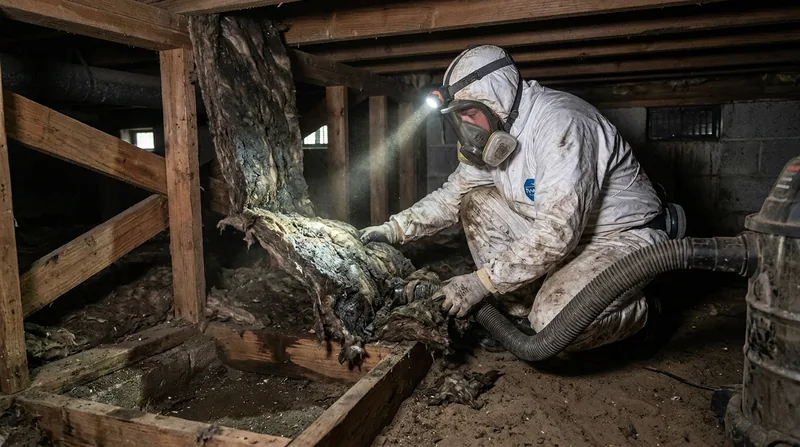




Attics and crawl spaces across Wilmington's older housing stock often hold decades of settled, moisture-damaged insulation that has lost its R-value and trapped humidity year-round. The mid-century ranches in Forest Hills, the historic downtown homes, and the raised-crawl-space foundations common throughout New Hanover and Brunswick counties all face the same problem: insulation removal is the necessary first step before any retrofit can begin. Whether your attic insulation has compressed from age, absorbed moisture from our hot humid summers, or simply never met code to begin with, we remove it safely, haul it away, and prepare the space for new spray foam or fiberglass. This page covers why removal matters in our climate, how we work, what it costs, and how to choose a contractor you can trust.
Why Insulation Removal Matters in Wilmington's Humid Climate
Wilmington sits in IECC climate zone 3A, warm and humid on the coast at the mouth of the Cape Fear River. In summer, moisture drives inward through walls and roofs, and vented crawl spaces pull in damp coastal air that settles under floors. When old insulation absorbs that moisture, it stops working. Fiberglass that was rated R-19 when new becomes R-8 when waterlogged. Settled blown-in insulation compacts into a thin mat that no longer fills the bay. The only honest fix is to remove what failed and start fresh.
- Moisture-damaged insulation loses R-value and traps humidity that feeds mold and rot in wood framing.
- Settled fiberglass and cellulose create cold spots in attics and crawl spaces, driving up cooling bills every month of the year.
- Old insulation often contains asbestos or other hazards that require careful handling and proper disposal.
- Removal clears the substrate so new foam can bond correctly and seal the space against air leaks.
Removing failed insulation is not optional when retrofitting to spray foam. It is the foundation of the job.
Key info: A typical attic in a mid-century Wilmington ranch holds 10 to 20 tons of settled fiberglass or cellulose. Removing it safely and hauling it away takes a full day and specialized equipment. We handle it so you do not have to.
For more on what comes after removal, see our page on attic spray foam insulation.
How We Remove Insulation in Wilmington: Our Process
Removal starts with a walkthrough to assess the type and depth of insulation, the condition of the attic or crawl space, and any obstacles or hazards. We then set up containment and mechanical ventilation to control dust and odor during the work. The insulation is removed by hand or with a vacuum system, depending on the material and the space. Once the space is clear, we inspect the substrate, seal any gaps or penetrations, and prepare for new foam or fiberglass installation.
- We assess the insulation type, depth, and condition before quoting the job, so you get an honest scope and price.
- We set up mechanical ventilation and containment to keep dust and debris out of your living space during the work.
- We remove insulation safely by hand or vacuum, depending on material type and the space we are working in.
- We haul away all removed material to a licensed disposal facility that accepts insulation waste.
- We inspect the substrate and identify any framing damage, pest activity, or moisture that needs attention before new insulation goes in.
The result is a clean, ready-to-insulate space with no hidden problems waiting to sabotage your retrofit.
Local example: A raised-crawl-space home in Hampstead with 40 years of settled fiberglass, vented to humid outdoor air, required full removal before we could install closed-cell foam to control condensation on the band joists and rim. The removal took one day. The new foam sealed the space and cut cooling bills by 18 percent in the first summer.
Once removal is complete, many homeowners move to closed cell spray foam insulation for superior moisture control in our coastal climate.
Insulation Removal Methods and Materials
| Removal Method | Description | Best for |
|---|---|---|
| Hand removal | Insulation is pulled from the space by hand, bagged, and hauled out. Slower but precise and suitable for tight or delicate spaces. | Small attics, crawl spaces with low headroom, homes with asbestos or other hazardous materials requiring careful handling. |
| Vacuum extraction | A truck-mounted vacuum system sucks insulation into a collection bin. Fast and efficient for large volumes of blown-in cellulose or fiberglass. | Large attics, deep blown-in insulation, properties where speed and minimal dust are priorities. |
| Batt and blanket removal | Fiberglass or mineral-wool batts are peeled from the framing and disposed of. Straightforward for older homes with traditional roll insulation. | Mid-century ranches with batt insulation, walls being retrofitted with injection foam, any space where batts are the original material. |
| Substrate preparation | After insulation is removed, we clean the space, seal air leaks, and repair or replace damaged framing as needed before new insulation is installed. | All removal jobs, especially crawl spaces and attics where moisture or pests have caused framing damage or mold growth. |
Each method is chosen based on the type and volume of insulation, the space available to work, and whether hazardous materials are present. We inspect the substrate during removal to catch problems early.
Insulation Removal Cost in Wilmington: What to Expect
Insulation removal in Wilmington typically starts at $950 for a small attic or crawl space, and scales up based on the volume of material, the accessibility of the space, and the complexity of the substrate. A large attic in a ranch home with 15 to 20 tons of settled fiberglass will cost more than a small crawl space with light blown-in cellulose. Access matters: if the attic hatch is in a closet on the second floor, the job is faster than if removal has to happen through a basement crawlspace entrance. The type of insulation also affects price. Batts come out quickly. Blown-in material requires vacuum extraction or hand bagging, which takes longer.
- Small attic removal (under 500 square feet, light insulation) typically runs $950 to $1,400 and includes hauling.
- Large attic removal (1,000 square feet or more, heavy settled fiberglass) runs $1,800 to $2,800 depending on depth and accessibility.
- Crawl space removal varies widely based on whether the space is vented or sealed and whether it holds water or moisture damage.
- Hazardous materials (asbestos, vermiculite) require specialized handling and disposal, which adds cost and time.
- Substrate repair (framing damage, mold treatment referral, air-sealing prep) is quoted separately after removal is complete.
The best way to know the real cost for your home is to get a written estimate with R-value and thickness specs. We offer free estimates within 24 hours at (910) 218-9739. See our full pricing page for more detail on what moves the needle.
Insulation Removal Near Me: What Wilmington Homeowners Should Know When Hiring
Hiring the right contractor for insulation removal is about more than price. You want someone who inspects the space honestly, gives you a written scope before starting, uses proper containment and ventilation during the work, and does not disappear the moment the truck drives away. Before you hire anyone, verify that they are fully insured and can provide proof of coverage. Ask for references from recent jobs in Wilmington, Carolina Beach, or Wrightsville Beach. Check whether your city requires a permit for the work. Some cities do, some do not. Your local building department can tell you in five minutes. If there is an HOA, check the architectural guidelines for any rules about exterior work or dumpster placement.
- Get at least two written estimates that include the square footage, insulation type, depth, and disposal cost.
- Verify full insurance coverage and ask for a certificate of insurance before any work begins.
- Check references from jobs done in your city or neighborhood within the past two years.
- Ask whether a permit is required at your address by calling your local building department, never the contractor.
- If you have an HOA, review architectural guidelines for any restrictions on dumpsters, exterior access, or noise during business hours.
- Confirm that the contractor uses mechanical ventilation during removal and specifies a re-entry window after any foam cure (if applicable).
A contractor who answers your questions clearly, provides a detailed estimate, and walks you through the process is worth the call. Contact us for a free estimate and see how we work.
Insulation Removal in Wilmington: Pricing Guide
| Service | Price | Details |
|---|---|---|
| Small attic removal | Starting at $950 | Light insulation under 500 square feet, includes hauling and basic substrate inspection for your retrofit |
| Large attic or crawl space removal | Starting at $1,800 | 1,000+ square feet of settled fiberglass or cellulose, vacuum extraction, full disposal, substrate preparation |
| Hazardous materials or complex substrate | On estimate | Asbestos, vermiculite, severe moisture damage, or framing repairs require site inspection before pricing |
| Travel and disposal | Included | No mileage fee or surprise charges in Wilmington and surrounding service areas, disposal at licensed facility |
| Free written estimate | No charge | Response within 24 hours at (910) 218-9739, includes R-value and thickness specs, no obligation to book |
Indicative pricing, the exact cost depends on square footage, finish, and site access. Free personalized estimate within 24h at (910) 218-9739.


