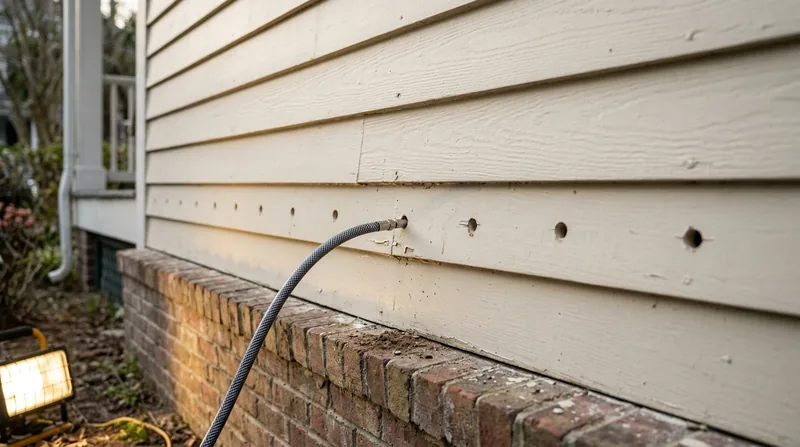




Wilmington's historic homes near downtown and in Forest Hills often feature finished walls with original plaster, vintage siding, or architectural details that make traditional insulation nearly impossible without demolition. Wall and injection foam insulation solves this problem by filling existing wall cavities through small drilled holes, restoring thermal control without disturbing the character of your home. The coastal plain climate here runs hot and humid for most of the year, with moisture-driven infiltration through walls accelerating cooling costs and creating conditions for settling insulation to lose effectiveness over decades. Older homes in neighborhoods like Airlie, Riverwalk, and downtown Wilmington sit over vented crawl spaces that pull humid air upward through rim joists and band joists, and uninsulated or poorly insulated walls compound the problem. We drill small injection ports, seal them after foam cures, and restore the wall to its original appearance while cutting drafts and stabilizing indoor temperature year-round.
Why Wall and Injection Foam Matters in Historic Wilmington Neighborhoods
Historic homes in Wilmington, Leland, and Carolina Beach were built when energy efficiency was not a design priority, and many sit with hollow walls that have never been insulated or contain only settled fiberglass that has lost R-value over time. Finished interior walls, plaster ceilings, and original exterior siding make cavity access impossible without tearing into the structure. Injection foam fills those cavities from the outside or inside through small holes, delivering thermal resistance without renovation cost or disruption to your home's original fabric.
- We drill small injection holes into the wall cavity at strategic points, usually on the exterior where they are less visible.
- Closed-cell or open-cell foam is injected under controlled pressure to fill the cavity completely and seal air leaks.
- Holes are patched and sealed, leaving no visible trace of the work.
- The finished wall gains R-value, air tightness, and thermal stability without any interior or exterior demolition.
This approach preserves the character and resale value of older homes while delivering the energy performance of a modern retrofit.
Key info: Homes in Forest Hills and downtown Wilmington built before 1980 typically have 2x4 wall cavities with no insulation or only settled fiberglass. Injection foam reaches those cavities without disturbing original plaster, trim, or exterior siding, making it the only practical retrofit for architecturally sensitive properties.
For more information on how spray foam works in older construction, see our closed-cell spray foam insulation page.
How Wall Injection Foam Insulation Works in Wilmington Homes
The injection process begins with a site inspection to locate wall cavities, identify the best drilling locations, and determine whether closed-cell or open-cell foam is appropriate for your walls and climate. We establish controlled injection points, drill small holes (typically 1 to 1.5 inches in diameter), and use specialized equipment to inject foam at the proper pressure and ratio. The foam expands to fill the cavity completely, seals air leaks around wiring and plumbing, and cures to a solid state. Holes are then patched with matching trim or sealant, and the wall returns to its original appearance.
- We assess the wall cavity depth, existing insulation, and structural condition before any drilling begins.
- Injection points are marked and drilled at intervals to ensure complete cavity fill without voids.
- Foam is injected using professional-grade equipment calibrated to the manufacturer's ratio and pressure specifications.
- We allow full cure time (typically 24 to 48 hours) before patching and finishing.
- Finished holes are sealed with caulk, foam backer rod, or trim that matches your home's original finish.
The result is a fully insulated wall cavity with no visible evidence of the work, and thermal performance that rivals new construction.
Local example: A mid-century ranch in Hampstead with 2x4 exterior walls and no cavity insulation typically requires 8 to 12 injection points per wall face, depending on wall length and cavity condition. The job takes one to two days, and the homeowner avoids tearing out drywall or removing exterior siding.
For details on our full air sealing approach, visit our air sealing services page.
Wall Injection Methods and Best Applications
| Approach | Description | Best for |
|---|---|---|
| Closed-Cell Injection | High-density foam with R-6.5 to R-7 per inch, excellent air seal and moisture resistance, requires mechanical ventilation during application. | Exterior walls in humid climates, walls below grade or near crawl spaces, homes where moisture control is critical. |
| Open-Cell Injection | Lower-density foam with R-3.5 to R-4 per inch, excellent air seal and sound dampening, breathable and less expensive than closed-cell. | Interior walls, walls in dry locations, homes where cost and sound control are priorities over maximum R-value. |
| Exterior Injection Points | Holes drilled on the outside of the house, typically above grade and in locations where patching is least visible. | Historic homes where interior walls cannot be disturbed, properties with original siding or architectural details that must be preserved. |
| Interior Injection Points | Holes drilled from inside the home, typically in basements, crawl spaces, or utility areas where access is easier and patches are hidden. | Homes with difficult exterior access, situations where interior wall cavities are accessible, retrofit work in finished spaces. |
Wall and Injection Foam Insulation Cost in Wilmington: What to Expect
Wall injection foam insulation in Wilmington typically ranges from $2 to $4 per square foot of wall cavity filled, depending on cavity depth, foam type, accessibility, and the number of injection points required. A typical mid-century home with 1,500 square feet of exterior wall area and 2x4 cavities will range from $3,000 to $6,000 for a complete retrofit using closed-cell foam. Open-cell foam costs less, typically $2 to $3 per square foot, and is a solid choice for interior walls or homes in dry locations. The final cost depends on several concrete factors: wall cavity depth (2x4 versus 2x6), foam type (closed-cell costs more but offers superior moisture resistance in Wilmington's humid climate), existing insulation (removing settled fiberglass adds labor), accessibility (exterior versus interior injection points), and the complexity of patching and finishing holes.
Getting 2 to 3 estimates from local contractors allows you to compare foam type recommendations, injection methods, and warranty terms. We provide written estimates that specify the foam type, R-value per inch, expected thickness, and the total square footage of wall cavity to be filled. Visit our pricing page for more details on our cost structure and to request a free estimate.
Wall and Injection Foam Insulation Near Me: What Wilmington Homeowners Should Know When Hiring a Contractor
When hiring a spray foam contractor for wall injection work, verify that the company carries full insurance coverage and can provide a certificate on request. Ask for references from recent wall injection jobs in your neighborhood or similar homes, and check that the contractor provides a written estimate that specifies foam type, R-value, thickness, and the method for patching injection holes. In Wilmington and surrounding areas, no separate permit is typically required for wall cavity insulation, but it is always wise to confirm with your local building department before work begins. If your home is in an HOA community or a historic district, check any architectural guidelines that might restrict exterior drilling or patching methods.
- Verify that the contractor is fully insured and can provide proof of coverage for spray foam installation work.
- Request at least two references from homeowners who have had wall injection foam installed in homes similar to yours.
- Confirm that the estimate includes the foam type, R-value per inch, expected cavity thickness, and the patching and finishing plan.
- Ask about the contractor's protocol for controlling odor and ventilation during and after the application.
- Confirm the re-entry window (typically 24 to 48 hours) and ask about any temporary odor or off-gassing expectations.
A reputable local contractor will answer all these questions clearly and provide a transparent estimate before any work begins. Contact us at (910) 218-9739 or visit our contact page to request a free estimate for your wall injection project.
Wall & Injection Foam Insulation in Wilmington: Pricing Guide
| Service | Price | Details |
|---|---|---|
| Wall Injection Foam (Closed-Cell) | Starting at $2.50/sq ft | Complete cavity fill with R-6.5 to R-7 per inch, best for moisture-prone exterior walls and humid climates like Wilmington |
| Wall Injection Foam (Open-Cell) | Starting at $1.75/sq ft | Cavity fill with R-3.5 to R-4 per inch, cost-effective choice for interior walls and dry locations, good sound dampening |
| Typical Retrofit (Historic Home) | From $3,500 to $6,000 | 1,500 to 2,000 square feet of exterior wall cavity using closed-cell foam, includes drilling, injection, and patching of holes |
| Insulation Removal Before Injection | On estimate | Required if existing settled fiberglass or other insulation must be cleared before foam injection can proceed safely |
| Travel and Estimate | Free | No travel charge in Wilmington and surrounding areas, free written estimate with R-value and thickness specifications included |
Indicative pricing, the exact cost depends on square footage, finish, and site access. Free personalized estimate within 24h at (910) 218-9739.


