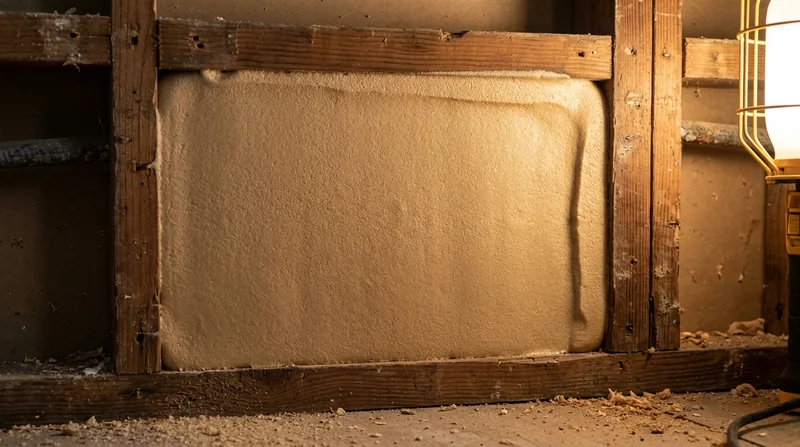




Closed cell spray foam insulation in Wilmington solves the wall cavity problem that haunts the city's historic downtown homes and older Forest Hills neighborhoods. Wilmington's coastal-plain geography and year-round humidity drive moisture inward through walls and roof assemblies, and narrow, irregular wall cavities in pre-1980 stock cannot hold conventional fiberglass without settling or leaving voids. Closed cell foam fills those cavities completely, adds structural rigidity to the wall, and blocks humid coastal air before it reaches the dew point inside the wall. The long hot season and hurricane-season moisture load make this the right choice for homes in the downtown core, along Wrightsville Beach, Carolina Beach, and the older subdivisions pushing toward Leland and Ogden. We work on new construction, retrofit work, and re-insulation projects across Greater Wilmington, and we size and specify every job on site.
Why Closed Cell Spray Foam Matters in Historic and Mid-Century Wilmington Homes
Wilmington's building stock divides into distinct zones, each with its own insulation challenge. Historic downtown and Forest Hills homes have narrow wall bays, plaster-and-lath construction, and cavities that were never insulated. Mid-century ranches pushed outward with wider framing and better ventilation, but their attics are often thin-insulated and their crawl spaces are vented, pulling in damp coastal air. Newer subdivisions toward Leland and Ogden use modern framing but still face the same humidity load. Closed cell foam addresses all three: it fills narrow cavities without settling, it adds strength to older framing, and it stops humidity migration that fiberglass cannot.
- Closed cell foam fills irregular cavities completely, eliminating the voids that plague blown-in or batts in historic homes.
- The foam adds structural rigidity to walls, bracing older framing against coastal wind loads and hurricane pressure.
- Dense closed cell blocks humidity migration before it reaches the cold surface inside the wall where condensation forms.
- R-value per inch is higher than open cell, so you get more insulation in tight spaces without adding thickness.
- The air seal is permanent; it does not settle or degrade like fiberglass batts over decades of humidity cycling.
Every one of these failures shows up in Wilmington homes: settled fiberglass in attics, damp walls in basements and crawl spaces, and structural sag in older framing. Closed cell foam fixes the moisture problem and the performance problem at the same time.
Key info: Wilmington sits in IECC climate zone 3A, warm and humid with moisture driving inward most of the year. The Cape Fear River mouth keeps humidity high even in winter, and summer cooling bills track directly to hot attics and uninsulated walls. Closed cell foam is the answer when you cannot afford settled insulation or voids in an older wall cavity.
For more on how we approach attic work in Wilmington homes, see our attic spray foam insulation service page.
How We Install Closed Cell Spray Foam Insulation in Wilmington: The Process
Every closed cell spray foam job in Wilmington starts with an on-site assessment. We measure wall cavities, check for moisture, verify the substrate is dry, and determine the R-value and thickness needed to meet code for your address. We then set up mechanical ventilation, spray the foam in controlled passes to the manufacturer specification, and establish a re-entry window of 24 to 48 hours. The foam cures to full strength, and we inspect thickness and coverage before we leave the site.
- We inspect the wall cavity and confirm the substrate is dry, sound, and ready to receive foam.
- We establish a moisture baseline and walk away if standing water or active leaks are present.
- We set up mechanical ventilation and control the spray environment to meet manufacturer standards.
- We spray closed cell foam in multiple thin passes, building thickness gradually to avoid overspray and waste.
- We verify R-value and thickness on site and provide written documentation of what was installed.
- We establish a re-entry window of 24 to 48 hours and advise you on ventilation and occupancy timing.
This controlled approach is what separates a professional installation from a rig-and-run crew that sprays in an afternoon and disappears. We stay accountable to the manufacturer spec and to you.
Example: A 1950s home in Forest Hills has a wall cavity that runs 3.5 inches between the old plaster and the rim joist. Fiberglass batts do not fit, and blown-in settles to 2 inches within a year. We spray closed cell to R-21 (3.5 inches at 6 pounds per cubic foot), fill the cavity completely, and stop the humidity that has been soaking the rim joist for seventy years. The homeowner gets a written estimate with R-value and thickness before we begin.
For more on how we handle wall cavities in older homes, see our wall and injection foam insulation service.
| Approach | Description | Best for |
|---|---|---|
| Wall cavity retrofit | Closed cell sprayed into existing wall cavities without demolition, filling voids and sealing air leaks. | Historic and mid-century homes where cavities are narrow or irregular and fiberglass has settled. |
| New construction walls | Closed cell sprayed at framing stage before drywall, achieving continuous air seal and structural bracing. | New builds in Leland, Ogden, and newer subdivisions where wall framing is open and accessible. |
| Rim joist and band joist | Closed cell applied to the rim board and band joist where the floor meets the rim, sealing the biggest air leak in the building envelope. | Homes with vented crawl spaces, where humid air enters at the rim joist and saturates the floor framing. |
| Sealed attic walls (knee walls) | Closed cell sprayed into the sloped wall of a sealed attic, creating an unvented roof deck and stopping moisture at the sheathing. | Attics converted to conditioned space or sealed roof decks where ventilation is not an option. |
| Metal building condensation control | Closed cell adhered to the underside of metal roof panels, preventing condensation on steel in humid coastal climates. | Barndominiums, pole barns, and metal buildings in Wilmington where temperature swings and humidity create drip problems. |
Closed Cell Spray Foam Insulation Cost in Wilmington: What to Expect
Closed cell spray foam insulation in Wilmington starts at approximately $1.20 per board foot, though the final cost depends on several site-specific factors. The square footage of wall cavity, the depth of the cavity, access to the work area, and whether the substrate is clean and dry all affect the price. A small retrofit of a rim joist in a crawl space may run $800 to $1,500, while a full-wall cavity in a historic home or a sealed attic retrofit can run $3,000 to $8,000 or more. We always provide a written estimate with R-value, thickness, and board-foot count before any work begins.
The best way to understand cost is to get two or three estimates from contractors you can verify. Compare the R-value and thickness specified in each estimate, not just the price. A low bid with no R-value spec and no thickness detail is a red flag. We provide a detailed written estimate at no charge, and we can walk you through what moves the price up or down for your specific wall or cavity.
For a full breakdown of pricing across all our services, see our pricing overview page.
Closed Cell Spray Foam Insulation Near Me: What to Look for When Hiring in Wilmington
Hiring a spray foam contractor in Wilmington requires the same diligence you would use for any structural or envelope work. The insulation trade includes rig-and-run crews with out-of-state rigs, national franchises, and local independents, and each carries different accountability. You should verify that any contractor you hire is fully insured, can provide references from local jobs, and will give you a written estimate with R-value and thickness before starting. Ask about their re-entry protocol, their mechanical ventilation during cure, and their warranty on workmanship. If a contractor promises immediate re-entry or skips ventilation during spray, walk away.
- Verify full insurance coverage and ask for a certificate of insurance naming you as additional insured.
- Request references from recent Wilmington jobs and call at least two to ask about the installer's communication and follow-up.
- Get a written estimate with R-value and thickness specified in board feet, not a vague price per square foot.
- Ask about mechanical ventilation during cure and the re-entry window the installer will establish.
- Confirm the contractor understands local permit requirements for your address and will help you navigate what applies.
- If your home is in an HOA, check whether exterior work or metal building insulation requires architectural approval before you schedule.
The strongest signal of a professional is a contractor who says no to a wet substrate, who explains why R-value and thickness matter, and who gives you a written estimate you can compare. We welcome your questions and your due diligence.
Ready to get started? Contact us for a free estimate or call (910) 218-9739.
Closed Cell Spray Foam Insulation in Wilmington: Pricing Guide
| Service | Price | Details |
|---|---|---|
| Closed cell spray foam (wall retrofit) | Starting at $1.20/board ft | Typical retrofit of narrow cavities in historic homes, sized by cavity depth and wall square footage |
| Rim joist and band joist sealing | Starting at $1.20/board ft | Closed cell applied to rim board where floor meets foundation, cost scales with joist length and perimeter |
| Sealed attic or knee wall retrofit | Starting at $1.20/board ft | Closed cell sprayed into sloped attic walls or knee walls, price depends on square footage and access |
| Metal building or barndominium condensation control | Starting at $1.20/board ft | Closed cell adhered to underside of metal roof panels, cost varies by panel area and building configuration |
| Travel and estimate | Included and free | No mileage charge in Wilmington and surrounding areas, free written estimate within 24 hours |
Indicative pricing, the exact cost depends on square footage, finish, and site access. Free personalized estimate within 24h at (910) 218-9739.


