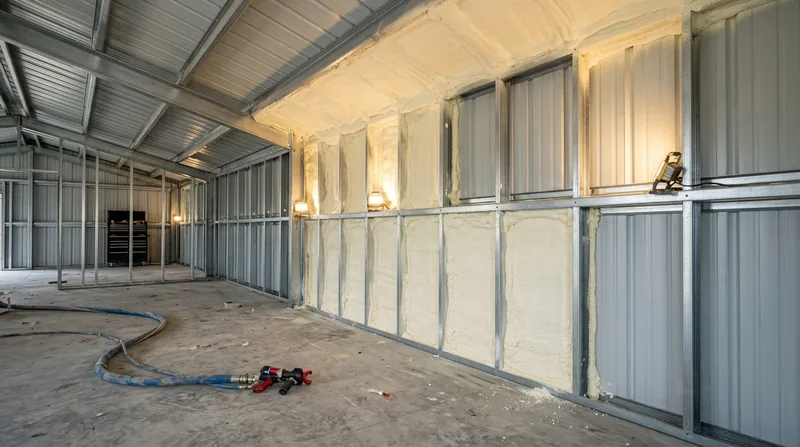




Metal Building & Barndominium Spray Foam in Wilmington stops the condensation that forms on steel when humid coastal air meets a cool interior skin. Metal structures across New Hanover County, from agricultural buildings near Castle Hayne to residential barndominiums in Leland and Ogden, sweat heavily during the long warm season. Closed cell foam applied to the interior of the metal envelope blocks that moisture before it pools on joists and flooring, adds structural rigidity against hurricane-force wind, and cuts the load on air conditioning that runs almost year-round in this climate. Wilmington Spray Foam Insulation has been installing spray foam on metal buildings since 2016, and we understand the specific failure modes that coastal humidity and thermal shock drive into uninsulated steel. A free estimate gets you a concrete proposal with R-value and thickness specs, not a sales pitch.
Why Metal Building & Barndominium Spray Foam Matters in Wilmington's Coastal Climate
The Cape Fear region sits in IECC climate zone 3A, warm and humid on the coast with moisture-driven demand that climbs every month from May through September. Metal buildings and barndominiums have no thermal mass and no vapor resistance in the skin itself, so when outdoor humidity meets cooler interior air (especially at night or early morning), condensation forms instantly on the underside of the metal. This drip settles on wood framing, electrical wiring, and stored goods, creating the conditions for rust, rot, and mold growth that no amount of ventilation can outrun. Closed cell spray foam stops that condensation at the source by creating an air-tight, moisture-resistant barrier on the interior surface of the metal.
- Closed cell foam blocks moisture vapor before it reaches the metal skin, eliminating the damp air layer where condensation forms.
- The foam adds structural rigidity to the metal frame, improving resistance to coastal wind loads and hurricane-force gusts.
- A sealed roof deck or wall assembly reduces the cooling load by stopping heat transfer through the metal, lowering air conditioning runtime and cost.
- The foam cures to a solid, durable surface that does not settle, compress, or lose R-value over decades of service.
Barndominiums and metal agricultural buildings in Wilmington, Leland, and surrounding areas face this moisture challenge every year, and spray foam addresses it directly where ventilation and dehumidification cannot.
Key info: A metal pole barn near Ogden or a barndominium in Castle Hayne will show condensation on the underside of the roof or walls within hours of a humid night followed by morning sun. This is not a ventilation problem; it is a thermal and moisture barrier problem, and spray foam solves it.
For more on the science and application of closed cell foam in demanding environments, see our closed cell spray foam insulation page.
How We Install Metal Building & Barndominium Spray Foam in Wilmington
Spray foam installation on a metal building or barndominium begins with a site assessment to identify the substrate, the existing thermal resistance (if any), and the moisture and condensation history. We measure the square footage of roof deck, walls, or both, and we determine whether the job calls for closed cell foam (the standard for metal buildings, because of its moisture resistance and rigidity) or open cell foam in a supplementary role. Once the scope is clear, we prepare the interior surface by removing any debris, verifying that electrical systems and any existing insulation are safe to work around, and setting up mechanical ventilation for the spray and cure period. We then apply closed cell foam in controlled passes, monitoring the thickness and spray pattern to achieve the specified R-value in the fewest applications. The foam cures in twenty-four to forty-eight hours, and we coordinate re-entry and any finishing work (vapor barriers, drywall, or mechanical systems) with the property owner.
- We inspect the metal substrate for corrosion, fastener condition, and any existing insulation or vapor barriers that must be removed or worked around.
- We set up mechanical ventilation during the spray and cure to control off-gassing and ensure safe re-entry within the stated window.
- We apply closed cell foam in controlled passes, checking thickness and coverage to meet the R-value specified in the estimate.
- We verify the cured foam for continuity and seal any voids or gaps with expanding foam or caulk to eliminate air leakage paths.
- We document the completed work with photographs and a summary of the R-value, thickness, and square footage applied.
The entire process, from estimate to completion, is transparent and documented in writing, so you know exactly what was installed and why.
Example: A barndominium in Leland with a metal roof deck and exposed steel framing received 2 inches of closed cell foam applied in two passes, achieving R-12 across the entire roof. The job took one day to spray and one day to cure. The owner reported no condensation on the underside of the roof in the humid months that followed, and cooling bills dropped measurably.
For details on how we handle air sealing around the foam application, see our air sealing page.
Spray Foam Installation Methods for Metal Buildings & Barndominiums
| Approach | Description | Best for |
|---|---|---|
| Closed Cell Foam, Full Coverage | 2 to 3 inches applied in controlled passes to roof deck, walls, or both, achieving R-12 to R-18 depending on thickness and climate load. | Metal barndominiums, agricultural buildings, and structures with high humidity or condensation history in coastal areas. |
| Closed Cell Foam, Partial Retrofit | Selective application to roof deck or high-condensation zones where full coverage is not feasible or cost-effective. | Existing metal buildings where budget or access limits the scope, or where only the roof deck needs thermal and moisture protection. |
| Closed Cell Foam with Thermal Barrier | Foam applied and finished with a Class A thermal barrier (paint, intumescent coating, or gypsum board) to meet code requirements for interior habitation. | Barndominiums, metal-frame residential buildings, and commercial spaces where occupied interior space requires fire rating and thermal protection. |
| Open Cell Foam, Supplementary | Lower-density foam applied over existing insulation or in cavities where closed cell rigidity is not needed and cost is a primary driver. | Metal buildings with existing fiberglass or other insulation where a top-up is needed and the substrate is dry and stable. |
Metal Building & Barndominium Spray Foam Cost in Wilmington: What to Expect
Spray foam for a metal building or barndominium in Wilmington typically starts at $1.75 per square foot for closed cell foam applied to a roof deck or walls, depending on thickness, access, and the condition of the substrate. A small metal building with 2,000 square feet of roof deck and straightforward access will run between $3,500 and $5,000 for 2 inches of closed cell foam. A larger barndominium with 4,000 square feet of combined roof and wall surface will cost $7,000 to $10,000 or more. The cost per square foot moves up if the roof is steep, if the interior has obstacles (HVAC ducts, electrical conduit, existing framing), or if the metal substrate is corroded or requires cleaning and prep work before foam can be applied safely.
Factors that affect your final cost include the R-value you choose (thicker foam costs more but delivers higher thermal resistance), the condition of the substrate (clean metal is faster and cheaper than metal that needs prep), and the size and complexity of the building. Thermal barrier requirements (paint or gypsum board finish) add to the bill if the space is occupied as a residence. We provide a written estimate that breaks down the square footage, R-value, thickness, and total cost, so you know exactly what you are paying for and why.
For a detailed pricing overview and to compare foam types and R-values, visit our pricing page. To schedule a free on-site estimate, call us at (910) 218-9739 or use our contact form.
Metal Building & Barndominium Spray Foam Near Me: What Wilmington Homeowners Should Know When Hiring
Hiring a spray foam contractor for a metal building or barndominium is a significant decision, and it pays to verify credentials and understand what you are getting before work begins. Start by confirming that the contractor is fully insured and can provide a certificate of insurance naming your property. Ask for references from similar jobs (other metal buildings or barndominiums in the area) and call at least two to ask about the quality of the work, whether the foam cured without issues, and whether the contractor was responsive during and after the job. Get written estimates from at least two contractors, and compare the R-value, thickness, and cost per square foot to make sure you understand what each bid includes. If your barndominium is in an HOA community, check whether the HOA has architectural rules that govern exterior work or the appearance of the finished foam, and confirm that your contractor is aware of any permitting or approval requirements before starting.
- Verify that the contractor is fully insured with a current certificate of insurance that covers spray foam application and property damage.
- Request written estimates that specify R-value, thickness in inches, square footage, and the type of foam (closed cell or open cell) being proposed.
- Ask about the contractor's experience with metal buildings and barndominiums specifically, and request references from completed jobs in Wilmington or nearby areas.
- Confirm that the contractor understands any HOA architectural requirements or local permitting rules that apply to your property before starting work.
- Clarify the re-entry timeline after the foam is sprayed, and ask about the ventilation plan during cure to ensure the property is safe to occupy.
A reputable local contractor will answer these questions directly and provide documentation without hesitation. For more guidance on what to expect from a professional spray foam installer, contact Wilmington Spray Foam Insulation at (910) 218-9739 or visit our contact page to request a free estimate.
Metal Building & Barndominium Spray Foam in Wilmington: Pricing Guide
| Service | Price | Details |
|---|---|---|
| Closed Cell Foam, Metal Roof Deck | Starting at $1.75/sq ft | 2 to 3 inches applied for R-12 to R-18 thermal and moisture protection on metal roof decks in coastal humidity zones |
| Closed Cell Foam, Metal Walls | Starting at $1.75/sq ft | Interior wall application to stop condensation and add rigidity, cost varies with wall height, access, and existing framing complexity |
| Full Barndominium Retrofit (Roof + Walls) | On estimate | Combined roof and wall coverage requires site measurement, substrate assessment, and thermal barrier finish specifications before a firm price is given |
| Existing Insulation Removal & Replacement | On estimate | If the metal building has old fiberglass or foam that must be removed before new spray foam is applied, removal cost depends on volume and disposal method |
| Travel | Included | No separate mileage fee for jobs in Wilmington, Leland, Carolina Beach, Wrightsville Beach, Hampstead, and surrounding service areas |
| Free Estimate | No charge | Written proposal with R-value, thickness, and cost breakdown, response within 24 hours at (910) 218-9739 |
Indicative pricing, the exact cost depends on square footage, finish, and site access. Free personalized estimate within 24h at (910) 218-9739.


