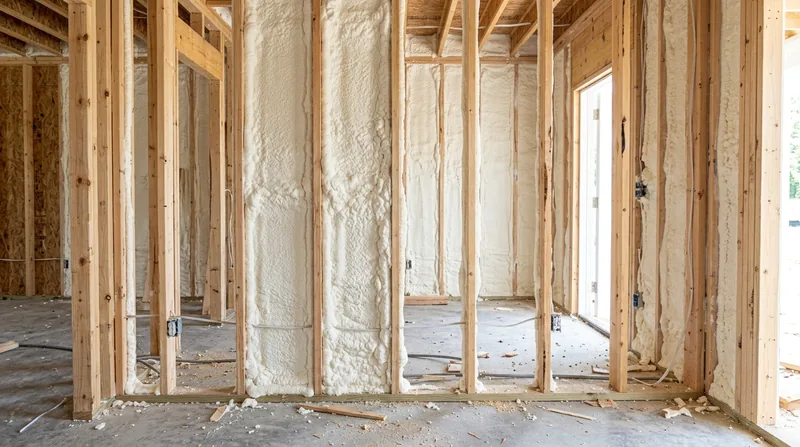




Open cell spray foam insulation fills the wide stud bays of newer subdivisions pushing toward Leland and Ogden, and softens sound in the irregular cavities of older homes near Forest Hills. Wilmington sits in IECC climate zone 3A, where hot humid summers and the long cooling season drive moisture inward through walls and attics. Open cell foam expands to seal those cavities completely, stops the air leakage that costs you money every month, and keeps the humidity load from building up inside your walls. Unlike closed cell, open cell is breathable, meaning moisture can still move through it and dry out. It is also the lower-cost entry point for spray foam work, and for attics and walls in homes across New Hanover and Brunswick counties, it is often the right choice. We have been installing spray foam insulation since 2016, and we know which product solves which problem in Wilmington's building stock.
Why Open Cell Spray Foam Insulation Matters in Coastal Wilmington
Wilmington's climate is the driver. The Cape Fear River mouth sits at the coast, humidity is high most of the year, and summer cooling bills climb steadily as attics bake and uninsulated cavities let conditioned air escape. Vented crawl spaces under older homes pull in damp coastal air, and newer subdivision homes toward Leland and Ogden often come with thin, settled insulation that no longer performs. Open cell foam seals the air leaks that fiberglass never touches, and because it is breathable, it works with the moisture that lives in this climate instead of trapping it.
- Open cell foam expands to fill irregular cavities in Forest Hills and downtown historic homes where framing does not follow modern spacing.
- It seals air leaks in the wide stud bays of newer subdivisions, stopping the convective losses that drive cooling costs higher.
- The material is lower cost per board foot than closed cell, making it the practical choice for attics and interior walls where moisture control is not the primary concern.
- Open cell softens airborne sound, reducing noise from outside and between rooms, which matters in homes near busy roads or in close-set subdivisions.
- It cures to a soft, compressible state that does not create pressure on framing or trap moisture that could rot wood or degrade drywall.
Getting open cell spray foam right in Wilmington means understanding that moisture is always present, and the foam must allow the house to dry when needed.
Local example: A mid-century ranch in Wrightsville Beach with original fiberglass in the attic and no rim joist insulation loses conditioned air constantly through the rim board and into the attic. Open cell foam seals the rim, stops the leakage, and in the attic, it fills the wide bays of that era's framing completely. The homeowner sees lower cooling bills and no moisture problems because the foam breathes.
For detailed guidance on permitting and the building code that applies to your specific address in Wilmington, contact the New Hanover County Building Inspections office or your city building department. They will tell you whether thermal barriers or ignition barriers are required, and which insulation products meet code in your jurisdiction.
How We Install Open Cell Spray Foam Insulation in Wilmington
Installation starts with a walk-through to identify air leaks, measure cavities, and confirm that the substrate is dry and sound. We remove any existing insulation that is damaged, settled, or blocking access. We seal obvious penetrations and prepare the space. Then we spray, controlling thickness on every pass, holding the manufacturer ratio and drum temperature, and running mechanical ventilation during cure. The job is not done until the space has cured properly and you have a written record of what was sprayed, where, and to what R-value and thickness.
- We inspect the attic, walls, or crawl space to find air leaks, moisture, and any substrate damage that must be fixed before foam is applied.
- We remove settled or failed insulation, debris, and any obstructions that would prevent foam from sealing cavities completely.
- We seal large penetrations around ducts, wires, and pipes so the foam fills only the cavity and not gaps around utilities.
- We spray open cell foam in controlled passes, measuring thickness and holding the ratio and temperature that the manufacturer requires.
- We run mechanical ventilation during cure and establish a re-entry window of twenty-four to forty-eight hours before the space is occupied.
- We provide a written estimate with R-value, thickness, and board-foot coverage so you know exactly what was installed.
This process takes longer than a rig-and-run crew would spend, but it is the only way to get a job that will not smell, will not off-gas, and will perform for decades.
Real example: A home in Leland with an open attic addition and new framing had wide 24-inch stud bays that fiberglass batts could never seal completely. Open cell foam was sprayed to R-19 (about 6.5 inches), filling every cavity and sealing the band joist where the addition meets the original structure. The homeowner got a written estimate showing the board footage, the thickness, and the R-value on each zone. Cure took forty-eight hours with the attic ventilation running, and the job was done right.
For more on how we handle attics specifically, see our page on attic spray foam insulation in Wilmington.
| Approach | Description | Best for |
|---|---|---|
| Open cell spray foam in attics | Sprayed to R-15 to R-21 (5 to 7 inches) in open bays, filling irregular rafter spacing and sealing the rim board. | Attics in mid-century and newer homes where air leakage is the main loss and moisture control is not critical. |
| Open cell spray foam in walls | Injected or sprayed into wall cavities to R-13 to R-15 (3.5 to 4.5 inches), filling narrow and irregular stud bays. | Exterior and interior walls in historic and mid-century homes where cavity depth and framing spacing vary widely. |
| Open cell spray foam in rim joists | Sprayed to fill the rim board cavity completely, sealing the thermal break between the foundation and the frame. | Homes with vented crawl spaces or basements where the rim joist is a major air leak and thermal loss. |
| Open cell spray foam in garage ceilings | Sprayed to R-15 to R-19 (5 to 6.5 inches) in the cavity between the garage and the living space above. | Attached garages where noise and temperature transfer to conditioned spaces is a concern. |
Open Cell Spray Foam Insulation Cost in Wilmington: What to Expect
Open cell spray foam starts at approximately $0.55 per board foot, but your final cost depends on the size of the space, the access, whether you need removal of old insulation, and the R-value you are targeting. An attic in a Leland subdivision with good access and no removal might run $1,500 to $3,000. A retrofit of walls in a Forest Hills historic home with difficult framing and partial removal could run higher. The only honest answer is to get three estimates, each with R-value and thickness spelled out in writing, so you can compare apples to apples.
- Board footage is measured on site and billed per board foot, so a written estimate is your protection against surprise invoices.
- Removal of old insulation adds cost but is often necessary, especially if the existing material is settled, contaminated, or blocking access.
- Access difficulty, such as a low attic or tight crawl space, increases labor time and may increase the per-board-foot cost.
- R-value targets vary by application, attic, or wall, so confirm the target in your estimate and understand why it was chosen.
- Travel is included in Wilmington and surrounding areas, with no separate mileage charge or call-out fee.
For a detailed pricing breakdown and to see what factors move the cost up or down, visit our full pricing overview.
What to Look for When Hiring an Open Cell Spray Foam Insulation Contractor Near Me in Wilmington
The spray foam market has rig-and-run crews that spray in an afternoon and disappear, national franchises with no local accountability, and local shops that will answer the phone when something goes wrong. Hiring the right contractor means checking credentials, getting multiple estimates, and understanding what you are paying for. Permitting and registration requirements vary by city across Greater Wilmington, so confirm what applies at your address before you hire anyone.
- Verify that the contractor is fully insured and ask to see a current certificate of insurance naming your address as the job site.
- Get written estimates from at least two contractors, each showing R-value, thickness, board footage, and the total cost per board foot.
- Ask whether the contractor will run mechanical ventilation during cure and what re-entry window they are committing to in writing.
- Check references from jobs completed in Wilmington, Leland, Carolina Beach, or nearby areas within the last two years.
- Confirm with the city or county building department whether a permit is required and what the local building code requires for thermal barriers or ignition barriers.
- If your home is in an HOA, check the architectural guidelines for any restrictions on exterior work or material choices.
The strongest signal of a competent contractor is a written estimate that names the R-value and thickness, not a vague price per square foot. Call us at (910) 218-9739 or request a free estimate online, and we will walk you through what we find and why open cell is or is not the right choice for your home.
Open Cell Spray Foam Insulation in Wilmington: Pricing Guide
| Service | Price | Details |
|---|---|---|
| Open cell spray foam, attic installation | Starting at $0.55/board ft | R-15 to R-21 (5 to 7 inches) in open bays, includes ventilation during cure and written R-value documentation |
| Open cell spray foam, wall insulation | Starting at $0.55/board ft | R-13 to R-15 (3.5 to 4.5 inches) in cavities, labor increases if framing is irregular or access is tight |
| Insulation removal and replacement | Starting at $0.75/board ft | Cost includes removal of old material, disposal, substrate prep, and new open cell foam installation |
| Rim joist and band joist sealing | Starting at $1,200 | Full rim board insulation and air sealing, cost varies by linear footage and access difficulty around foundation |
| Travel and estimate | Included and free | No separate mileage or call-out charge in Wilmington and surrounding service areas, response within twenty-four hours |
Indicative pricing, the exact cost depends on square footage, finish, and site access. Free personalized estimate within 24h at (910) 218-9739.


