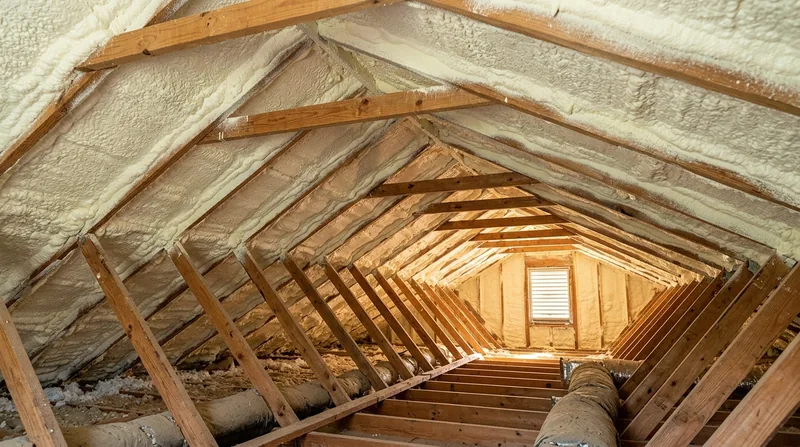




Wilmington attics bake through long, humid summers that push cooling bills higher every year. Mid-century ranches and older Forest Hills homes often still carry thin, settled insulation from decades past, while even newer construction toward Leland and Ogden can fall short when summer heat drives inward through unprotected roof decks. Attic spray foam insulation in Wilmington stops that heat gain at the source, seals the air leaks that fiberglass misses, and protects wood joists from the moisture that settles in hot, humid attics. We spray foam across attic floors and sealed roof decks to cut summer cooling load and extend the life of your framing. This is the signature job of the spray foam trade, and it is the single biggest ticket for most homeowners in New Hanover County.
Why Attic Spray Foam Insulation Matters in Wilmington's Hot, Humid Climate
Coastal North Carolina sits in IECC climate zone 3A, and Wilmington's location at the mouth of the Cape Fear River means humidity bears down most of the year. Summer heat drives moisture inward through walls and roofs, and that moisture settles into wood framing and insulation where air movement slows. A vented attic in summer pulls in hot, humid outside air, then cools slightly under the roof deck, and moisture condenses on rafters and joists. Thin, settled fiberglass does not stop that moisture or that heat gain. Spray foam seals the air path and creates a thermal and moisture barrier in one pass.
- We spray foam across the attic floor to insulate the living space below and stop summer heat from radiating down through joists.
- We seal the rim and band joists where the attic meets the exterior wall, closing the air gap that fiberglass leaves open.
- We spray the underside of the roof deck to create a sealed, conditioned attic that does not pull in damp coastal air.
- We identify and seal penetrations around plumbing vents, electrical chases, and ductwork that leak both air and moisture.
Each of these steps cuts cooling load, stops moisture from settling into wood, and extends the life of your attic framing.
Key info: A Forest Hills home with a thin, settled attic insulation can see indoor temperatures climb 10 to 15 degrees above the outside air in midsummer. Sealed attic foam cuts that temperature rise by 40 to 60 percent because it stops both heat gain and the air circulation that carries humidity into the space.
North Carolina building code governs attic ventilation, ignition barriers, and thermal barriers at your address. The fifteen-minute thermal barrier (the code distinction between open and closed cell foam) is determined by your building official, not by us. We work with your local building department to confirm what applies to your home and ensure the job meets code. For details on permit requirements in Wilmington, contact the City of Wilmington Building Inspections Department or your county building office.
How We Install Attic Spray Foam Insulation in Wilmington: Process and Methods
Every attic is different. Some have active roof leaks, standing water, or contamination that must be fixed first or we walk away. Others are sound but poorly insulated, with sagging fiberglass or no insulation at all. We inspect the attic, confirm the substrate is clean and dry, identify all air leaks and penetrations, and then choose the method that fits your home and your budget.
- We inspect the attic for roof leaks, standing water, mold, or contamination that must be remediated before foam is sprayed.
- We identify all air leaks: rim joists, band joists, ductwork penetrations, electrical chases, plumbing vents, and soffit vents.
- We remove settled or failed insulation if the substrate underneath is sound, or we recommend full insulation removal and replacement if contamination is present.
- We spray foam at the specified thickness and R-value, controlling the ratio and drum temperature to ensure a proper cure.
- We provide mechanical ventilation during cure and a re-entry window of 24 to 48 hours before the attic is occupied.
The result is a sealed, insulated attic that stops heat and moisture from degrading your home's envelope.
Local example: A 1960s ranch in Hampstead with a vented attic and R-11 fiberglass gets a sealed attic foam spray at R-21 thickness. The attic temperature drops 12 degrees in summer, the cooling system cycles less, and the wood joists stay dry. The job takes one day, and the homeowner sees the difference in their August power bill.
If your attic has failed insulation or you are not sure whether foam or blown-in is the right choice, contact us for a free estimate. We will walk through the options and recommend what makes sense for your home.
Attic Spray Foam Insulation Methods: Closed Cell vs. Open Cell
| Approach | Description | Best for |
|---|---|---|
| Closed Cell Spray Foam | Dense, rigid foam at 2 to 2.5 pounds per cubic foot. R-value 6 to 6.5 per inch. Stops air, vapor, and liquid water in one layer. | Sealed attics in humid climates, roof decks exposed to weather, attics with moisture risk, maximum R-value in minimum thickness. |
| Open Cell Spray Foam | Soft, semi-rigid foam at 0.5 to 0.6 pounds per cubic foot. R-value 3.5 to 3.6 per inch. Air seal with vapor permeability for drying. | Attic floors in vented attics, sound dampening, lower cost, situations where attic ventilation is required by code. |
| Rim and Band Joist Foam | Closed cell foam sprayed into the rim cavity where the attic meets the exterior wall. Seals the air path and stops moisture infiltration. | All attics in Wilmington. The rim joist is the single biggest air leak in most homes and the fastest ROI on insulation spending. |
| Blown-In Fiberglass (Top-Up) | Loose-fill fiberglass added over existing settled insulation. Low cost. Does not seal air leaks or stop moisture. | Sound attics with settled but intact insulation, no air leak issues, budget-constrained retrofits. Not recommended for Wilmington's humidity. |
Wilmington's heat and humidity favor closed cell foam on sealed attic projects and closed cell on rim joists in all cases. Open cell works for attic floors in vented attics where code requires ventilation. If your attic is sound and you are adding thickness to existing insulation, blown-in fiberglass may be the right answer and we will say so.
Attic Spray Foam Insulation Cost in Wilmington: What to Expect
Attic spray foam insulation in Wilmington typically starts at $1.50 per square foot for open cell foam on attic floors, and rises to $2.50 to $3.50 per square foot for closed cell foam on sealed attics or roof decks. The final price depends on the size of the attic, the R-value and thickness you choose, access to the space, whether existing insulation must be removed, and the complexity of air sealing around penetrations and rim joists.
- A 1,200-square-foot attic floor with open cell foam at R-19 typically costs between $1,800 and $2,400.
- The same attic with closed cell foam at R-21 typically costs between $3,000 and $4,200.
- Rim and band joist sealing on a home with 150 linear feet of rim typically costs $800 to $1,500.
- Removal of settled or failed insulation adds $0.25 to $0.50 per square foot, depending on the material and contamination level.
The best way to know what your job will cost is to get a written estimate with R-value and thickness specs. We provide estimates at no charge and with no obligation. The estimate includes a site inspection, a detailed scope of work, and a breakdown of labor and materials. For pricing details and to request an estimate, visit our pricing page or call us at (910) 218-9739.
Attic Spray Foam Insulation Near Me: What Wilmington Homeowners Should Know When Hiring a Contractor
The spray foam trade has its share of rig-and-run crews and national franchises that spray a job in an afternoon and vanish when the smell will not go away or the foam does not cure properly. A local, independent contractor with a local address and accountability is your best protection. When you call a spray foam insulation contractor near Wilmington, ask these questions and verify the answers before you sign an estimate.
- Ask for a written estimate that specifies R-value, foam thickness in inches, and the method (closed cell or open cell). Any estimate without these specs is a red flag.
- Verify that the contractor carries general liability insurance and workers compensation insurance. Ask for a certificate of insurance naming your address.
- Ask whether the contractor will provide mechanical ventilation during cure and what re-entry window they recommend (24 to 48 hours is correct).
- Check references from recent jobs in Wilmington, Carolina Beach, or Wrightsville Beach, and ask whether the homeowner would hire the same contractor again.
- Confirm that your local building department has been notified and that any required permits have been pulled before work begins.
- Ask whether the contractor will inspect the attic for roof leaks, standing water, or contamination before spraying, and whether they will walk away if the substrate is not dry and clean.
If you are in a master-planned community or an HOA, check your architectural guidelines before scheduling the work. Insulation work inside the attic rarely requires HOA approval, but exterior work on metal buildings or exterior ductwork may. Get approval in writing before any work begins.
Ready to move forward? Contact us today for a free, no-obligation estimate. We respond within 24 hours and can usually schedule work within one to two weeks.
Attic Spray Foam Insulation in Wilmington: Pricing Guide
| Service | Price | Details |
|---|---|---|
| Open Cell Spray Foam Attic Floor | Starting at $1.50/sq ft | R-19 to R-25 thickness on attic floors in vented attics. Cost varies with attic size and air sealing complexity |
| Closed Cell Spray Foam Attic Floor or Sealed Roof Deck | Starting at $2.50/sq ft | R-21 to R-30 density and thickness for sealed attics and roof decks. Includes vapor barrier and moisture control |
| Rim Joist and Band Joist Sealing | Starting at $800 | 150 to 200 linear feet of closed cell foam in rim cavity. Typical home rim sealing adds $800 to $1,500 to attic project |
| Insulation Removal and Replacement | Starting at $0.25/sq ft removal | Cost depends on material type, contamination level, and disposal requirements. Often necessary before foam spray on older homes |
| Travel and Estimate | Included and Free | No mileage fees or travel charges in Wilmington and surrounding areas. Free written estimate with 24-hour response |
Indicative pricing, the exact cost depends on square footage, finish, and site access. Free personalized estimate within 24h at (910) 218-9739.


