Understanding Your Insulation Options in Wilmington
When homeowners in Wilmington think about improving their home's energy efficiency, they often face a critical question: should they invest in air sealing alone, or should they upgrade to full spray foam insulation? The answer depends on your home's current condition, your budget, and your long-term energy goals. Both approaches have merit, but they serve different purposes and deliver different results.
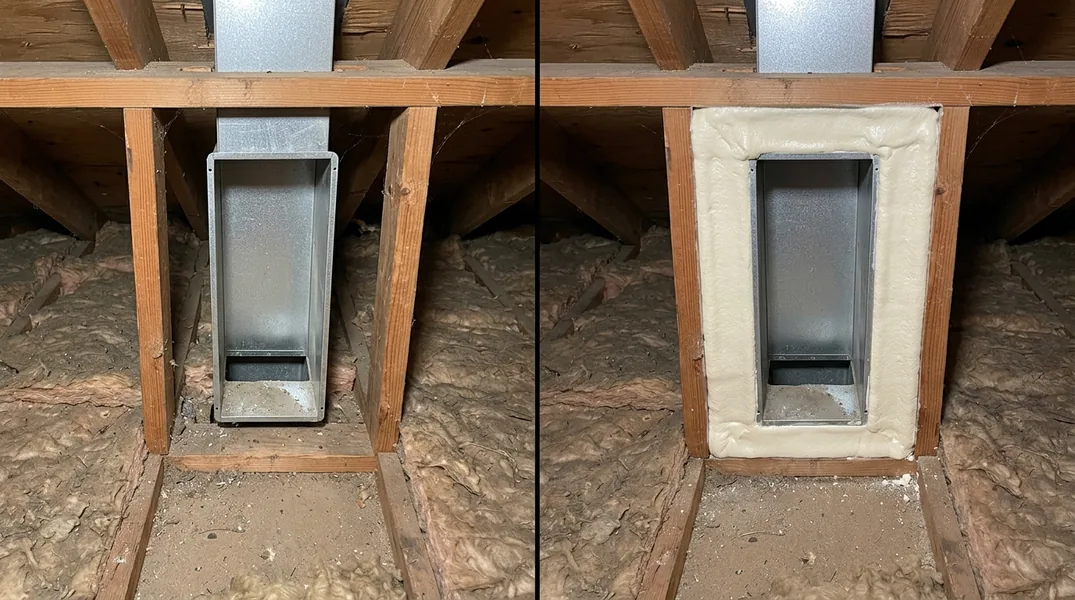
Air sealing focuses on closing gaps, cracks, and penetrations where conditioned air escapes. It's typically done around electrical outlets, window frames, door frames, and where utilities enter your home. Full Attic Spray Foam Insulation, on the other hand, provides both air sealing and thermal resistance in one application. Understanding the differences between these approaches will help you make an informed decision about what your home actually needs.
What is Spray Foam Insulation and How Does R-Value Work?
Spray foam insulation comes in two main types: Closed Cell Spray Foam Insulation and Open Cell Spray Foam Insulation. The R-value is a measurement of thermal resistance, meaning how well the material prevents heat from flowing through it. Higher R-values indicate better insulation performance. Closed cell spray foam typically offers an R-value of 6 to 7 per inch, while open cell spray foam provides approximately 3.5 to 3.6 per inch.
The difference in spray foam insulation R value per inch matters significantly when determining how thick your insulation needs to be. If you choose closed cell, you'll need less thickness to achieve the same R-value as open cell foam. However, closed cell is more expensive, while open cell is more budget-friendly and still provides excellent air sealing benefits. North Carolina's climate, with its moderate winters and humid summers, typically requires an attic R-value between R-38 and R-49, depending on your specific location and energy goals. This means you might need 6 to 7 inches of closed cell foam or 11 to 14 inches of open cell foam to meet these standards.
R-Value Requirements by State: Where Does North Carolina Stand?
Understanding r value requirements by state helps homeowners understand what their home needs to meet current building codes and energy efficiency standards. North Carolina follows the International Energy Conservation Code (IECC), which recommends different R-values based on climate zones. Wilmington falls into a zone that requires R-38 to R-49 for attic insulation, depending on whether you're building new or retrofitting an existing home.
These requirements exist for a reason. Proper insulation reduces your heating and cooling costs, improves indoor comfort, and extends the life of your HVAC system. If your home is significantly under-insulated, you're likely paying more on energy bills than necessary. Many homeowners in the Leland and surrounding areas discover that their homes were built with insufficient insulation, especially older properties. A professional energy audit can reveal exactly where your home stands relative to current standards.
How Thick Should Spray Foam Be? Finding the Right Depth
The question of how thick should spray foam be depends on several factors: your target R-value, the type of foam you choose, and your home's specific needs. As mentioned earlier, closed cell spray foam achieves higher R-values per inch, so you can reach R-38 with approximately 6 to 7 inches. Open cell foam requires roughly 11 to 14 inches to achieve the same R-value. The thickness also affects cost, installation time, and the structural considerations for your attic space.
Beyond R-value, thickness also impacts air sealing effectiveness. Even a thin layer of spray foam creates an air barrier that prevents infiltration and exfiltration of conditioned air. Some homeowners choose a hybrid approach: using thinner spray foam for air sealing combined with traditional insulation for additional R-value. This can be more cost-effective while still delivering excellent performance. The best thickness for your home depends on your budget, your energy efficiency goals, and whether you're retrofitting an existing attic or insulating a new space. Wilmington Spray Foam Insulation can evaluate your specific situation and recommend the ideal thickness during a free estimate.
Insulation Tax Credits and Rebates: Making Your Investment More Affordable
One of the most attractive aspects of upgrading your home's insulation is the potential for financial incentives. An insulation tax credit can significantly reduce the cost of your project. The federal government offers tax credits for energy-efficient home improvements, including insulation upgrades. These credits can cover a percentage of your material and labor costs, making spray foam insulation more accessible for budget-conscious homeowners.
Beyond federal incentives, many utility companies and local programs offer insulation rebates. These programs are designed to encourage homeowners to improve energy efficiency and reduce peak demand on the electrical grid. The specific amount of rebates available in your area depends on your utility provider and local programs. Some rebates are applied at the point of purchase, while others require you to submit documentation after installation. When you contact Wilmington Spray Foam Insulation at (910) 218-9739, our team can discuss available incentives and help you understand how tax credits and rebates might apply to your project. We stay current on local and federal programs to ensure our customers take advantage of every opportunity to reduce their out-of-pocket costs.
Air Sealing vs. Full Spray Foam: Making Your Decision
So which approach is right for your home? Air sealing alone is an excellent choice if your attic already has adequate insulation but you're experiencing drafts, temperature inconsistencies, or higher-than-expected energy bills. Air sealing addresses the root cause of many comfort and efficiency problems. However, if your home is under-insulated and has air leakage issues, you're addressing only half the problem with air sealing alone.
Full spray foam insulation solves both problems simultaneously. It seals air leaks while providing thermal resistance, delivering superior energy efficiency in a single application. The upfront cost is higher, but the long-term savings on energy bills often justify the investment, especially when you factor in tax credits and rebates. For most homes in Carolina Beach, Wrightsville Beach, and surrounding areas, spray foam represents the most comprehensive solution. If you're unsure which approach fits your situation, a professional energy assessment can provide clarity. Wilmington Spray Foam Insulation offers personalized consultations to help you understand your home's specific needs and the best path forward.
Getting Your Free Estimate: Next Steps for Wilmington Homeowners
Ready to improve your home's insulation and energy efficiency? The first step is scheduling a consultation with Wilmington Spray Foam Insulation. Our team will evaluate your attic, discuss your goals, and explain how spray foam can benefit your specific home. We'll address questions about pricing, installation timelines, and available incentives during your visit.
Contact us at (910) 218-9739 or visit our website to request your free estimate. We serve Wilmington and the surrounding areas with professional spray foam installation services. Whether you're considering Wall & Injection Foam Insulation or attic solutions, our experienced team is ready to help you make the right decision for your home and budget.
Looking for a professional spray foam insulation contractor in Wilmington? Wilmington Spray Foam Insulation responds fast for all your spray foam insulation needs.
Get a Free Quote